
AI is becoming remarkably good at producing target lists. The defensible advantage comes later: connecting a candidate to independent biology, exposing the assumptions behind its rank and designing the experiment most likely to prove the hypothesis wrong.
Related: For an introduction to the discovery workflow, read AI-powered target identification: how to identify disease-relevant targets with AI.
Target identification is an evidence-integration problem
A target is not simply a gene associated with a disease. It is a therapeutic hypothesis: modulating a defined biological entity, in a defined patient and disease context, should produce a meaningful effect with an acceptable safety profile. That hypothesis must survive questions about causality, cellular context, tractability, selectivity and translation.
AI helps because the relevant evidence is distributed across genetics, transcriptomics, proteomics, single-cell and spatial measurements, perturbation screens, literature, protein structures and clinical observations. No scientist can inspect every relationship at full resolution. A model can organize this hypothesis space, but it cannot make heterogeneous evidence independent merely by combining it.
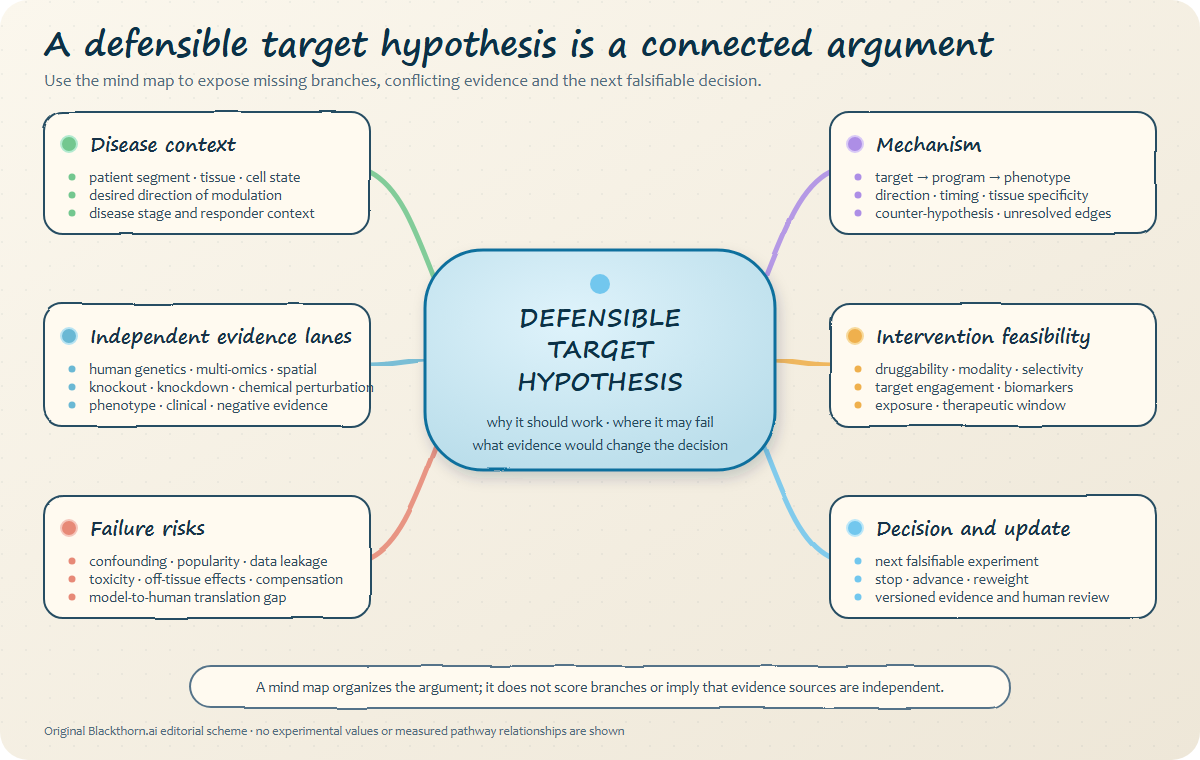
The distinction matters. A literature edge, a pathway annotation and a knowledge-graph connection may all trace back to the same experiment. Treating them as three votes creates confidence without adding information. A credible system preserves provenance and dependence instead of collapsing everything into an opaque score.
What a serious AI-generated hypothesis looks like
The XunZi study offers a useful example because it connects computational ranking to progressively stronger experiments. XunZi combines a biomedical reasoning model with a graph-convolutional module trained to integrate protein interactions, biological-process annotations and disease-specific multi-omics data. The authors evaluated the combined system in cancer and neurodegenerative-disease settings, while also acknowledging uncertain negative labels, potential overfitting and bias introduced by human curation.
In non-small-cell lung cancer, the team screened 20 highly ranked, previously unreported candidates in A549 cells. Knockdown of five reduced cell viability; for MYO1B, knockdown also reduced AKT and ERK phosphorylation. This moved the result from computational association to a context-specific perturbation with a mechanistic readout – but it remained a cell-line finding.
The Parkinson's disease work went further. CHK2 emerged from a kinase-prioritization exercise informed by transcriptomic, proteomic and phosphoproteomic data. Genetic reduction of Chk2 and treatment with the inhibitor CCT241533 improved motor, molecular and dopaminergic-neuron readouts in two mouse models. The study also reported overlap between transcriptional responses to CHK2 and LRRK2 inhibition, while leaving open whether CHK2 directly phosphorylates LRRK2.
That last qualification is important. The experiments support a preclinical disease-modifying hypothesis; they do not establish efficacy or safety in people. A strong target narrative makes that boundary visible.
Evidence aggregation can matter as much as model complexity
Target rankings can change before a sophisticated model even begins. In a chemical-proteomics study, combining peptide-level p-values with Fisher's method – particularly using the top four peptides – improved target ranking across the evaluated datasets and recovered thymidylate synthase for raltitrexed. The practical lesson is broader than this statistical method: preprocessing and aggregation choices are part of the scientific hypothesis, not neutral plumbing.
Multimodal does not automatically mean causal
Multi-omics data provide complementary views of disease, but each layer answers a different question. Genetics can anchor a target to human disease risk. Transcriptomics and proteomics reveal state and response. Phosphoproteomics can expose active signalling. Single-cell and spatial assays resolve which cells carry the signal and where they sit. Perturbation experiments test whether changing the target changes a phenotype.
Early, intermediate and late integration strategies make different trade-offs around missing values, dimensionality, platform noise and interpretability. Concatenating every feature may preserve detail while magnifying batch effects and sample-size problems. A shared latent representation may capture cross-modal structure while making the learned biology harder to inspect. Late integration is easier to audit, but may miss interactions that only appear across layers.
Phenotypic signatures add another route. Drug-induced expression profiles and cell morphology can connect compounds, pathways and candidate targets even when structural information is sparse. But a shared signature can reflect a common downstream stress response rather than direct target engagement. It should guide deconvolution experiments, not substitute for them.
From multimodal signals to testable causal pathways
With sufficiently rich data, a model can do more than score known target-disease pairs. It can propose a directed pathway: a regulator changes a biological program, the program changes a disease-relevant phenotype, and a target sits at a point where intervention may redirect that sequence. Genetics, time-resolved measurements and perturbation data can help orient edges that would remain ambiguous in a correlation network. Recent work combining loss-of-function human genetics with Perturb-seq illustrates this regulator-to-program-to-trait logic, while also warning that a complete genome-scale causal graph remains beyond what current perturbation data can reliably identify.
These pathways should be treated as versioned hypotheses, not newly discovered truth. Each edge needs its own evidence state: observed association, intervention-supported direction, model inference, contradiction or unresolved gap. Trustworthiness is better represented as a profile than a single score. Useful checks include precision and recall against justified reference edges, structural error in simulations, prediction of held-out perturbational responses, stability across resamples and model settings, replication across datasets or cell systems, and agreement with independent human-genetic or mechanistic evidence.
Proprietary data can make this especially valuable. A disease-relevant CRISPR screen, patient-derived model, internal proteomics dataset or failed experiment can reweight existing paths, weaken popular but unsupported edges, and reveal context-specific connections absent from public resources. The system should preserve the public-data graph and the proprietary-data revision side by side, showing which edges appeared, disappeared or changed weight. That revision is a better experimental hypothesis; it is not automatic causal proof.
Data-driven causal pathways can also reduce the pull of popularity. Instead of rewarding an edge because it appears in many papers or databases, the model can group dependent records, retain negative evidence, and ask whether the proposed direction predicts an intervention in the relevant context. This can weaken false or merely fashionable connections—but only if the system measures source dependence and bias. An AI trained naively on literature frequency may amplify the same popularity effect it is meant to correct.
The longer-term opportunity is a continuously updated evidence model. New publications, datasets and internal experiments can trigger a versioned comparison with the current target landscape: which assets gained or lost mechanistic support, which edges changed direction or weight, and which established assumptions no longer fit the evidence. AI can perform that monitoring and propose alerts autonomously. It should not silently rewrite the accepted scientific position; material changes should arrive with provenance, uncertainty, affected claims and a request for accountable human review.
Three ways a convincing model can still be wrong
1. The benchmark rewards yesterday's development decisions
Disease-specific benchmarking is an improvement over one universal target score. TargetPro, for example, built models across 38 diseases and evaluated recovery of clinical-stage targets. Yet the authors explicitly note that historical clinical labels encode commercial and strategic attrition as well as biology. A model can therefore learn which targets looked investable under past conditions rather than which mechanisms are causally correct.
Time-sliced evaluation helps by asking whether a model can recover targets that became visible only later. It still needs leakage checks, disease-specific calibration and external replication.
2. The knowledge graph rewards popularity
Knowledge graphs are powerful because they make relationships inspectable and can expose long mechanistic paths. TargetMap demonstrates how full-path reasoning can turn graph topology into a coherent mechanistic narrative. But a coherent path is not causal evidence, and the graph inherits the literature's preferences.
The risk is not theoretical. An analysis of network-pharmacology studies in ethnopharmacology found strikingly repetitive metabolites, hub targets and canonical pathways across dissimilar questions. Across several top-k thresholds, flavonoids represented 70-80% of the most frequent metabolites in that specific corpus. The number should not be generalized outside that domain; the warning should. Reproducibility can faithfully reproduce a biased discovery pipeline.
3. Retrospective accuracy is mistaken for therapeutic validation
Model metrics answer whether predictions match a chosen label under a chosen split. They do not establish that target modulation will change disease biology, that the effect is safe or that it will translate into patients.
The evidentiary burden should rise with the consequence of the decision. A low-cost hypothesis-generation task may need reproducible code and a robust holdout. A programme-level target decision needs orthogonal perturbations, relevant biological models, dose and temporal reasoning, tractability and safety analysis, and ultimately human-relevant evidence.
Validation should be designed as a ladder
MIDAS illustrates an intermediate rung between retrospective benchmarking and clinical proof. The model integrated patient molecular profiles, single-cell immune data, HLA peptidomics, gene-phenotype associations and CRISPR perturbation data. It used time-sliced evaluation and then tested OSM-OSMR signalling in patient-derived tumour explants. Perturbation reduced dysfunctional CD8-positive T-cell and CCL4 readouts in that experimental context.
This is substantially stronger than recovering known targets in a benchmark. It is still not evidence of clinical efficacy. Patient-derived systems preserve aspects of human biology that cell lines miss, but they remain bounded models with selected endpoints.
The practical hierarchy is:
- Retrospective validity: frozen data, leakage-resistant splits, appropriate negatives, calibration and sensitivity analysis.
- Orthogonal perturbation: CRISPR knockout or interference, RNAi, overexpression, rescue and chemical modulation treated as distinct evidence.
- Context validity: the right cell type, tissue, disease state, dose, timing and comparator.
- Mechanistic coherence: pathway, target-engagement and downstream readouts that can distinguish the proposed mechanism from alternatives.
- Human relevance: genetics, patient-derived material, prospective samples and, eventually, clinical evidence.
A practical blueprint for target teams
Start with the decision, not the dataset
Define the disease context, patient segment, desired direction of modulation, therapeutic modality and reasons to stop. A target model without a target product hypothesis will optimize a vague label.
Keep evidence lanes separate
Record genetics, perturbation, multi-omics, network context, tractability and safety as distinct lanes. Preserve source versions, model systems, tissue context and negative results. Do not let ten database-derived features masquerade as ten independent experiments.
Make the ranking falsifiable
For every high-priority target, require an explicit mechanism, counter-hypothesis, predicted responder context and next experiment. The output should say what observation would lower confidence.
Stress-test the model before biology pays the bill
Use temporal splits, dataset holdouts, alternative negative definitions, ablations and perturbations of preprocessing choices. Inspect whether the model mostly rediscovers proximity, publication density or clinical familiarity.
Design orthogonal validation
Combine genetic and chemical perturbation where possible. Add rescue experiments to separate on-target biology from general toxicity. Measure target engagement and pathway effects rather than relying on a single terminal phenotype.
Update the evidence, not just the score
When an experiment disagrees with the ranking, preserve the contradiction. The system should explain how the new result changes the hypothesis and which uncertainty remains.
The deliverable is an argument a scientist can challenge
AI can compress an enormous search space and reveal relationships that are difficult to see manually. Its value is not that it makes target selection automatic. Its value is that it can make the reasoning systematic, traceable and easier to test.
The strongest target-identification systems will therefore be judged by more than hit rate. They will show where the evidence came from, distinguish independent support from repeated information, expose uncertainty, and convert a ranking into a falsifiable experimental plan.
That is the point at which an AI-generated target becomes useful: not when it reaches the top of a list, but when a discovery team knows exactly why it is there and what to do next.
How Blackthorn.ai approaches target-identification work
Blackthorn.ai helps research teams turn fragmented literature, multi-omics and perturbation evidence into traceable target hypotheses and decision-ready validation plans. If your team is evaluating a target landscape or deciding which evidence gap to close next, talk with us.
References
- Huang X. et al. XunZi, an AI biologist, reveals disease-modifying targets. *Nature Biomedical Engineering* (2026).
- Chen H. et al. Integrating multi-omics and artificial intelligence fuels advanced target identification and drug discovery. *Biotechnology Advances* 87, 108785 (2026).
- Pun F.W. et al. Target identification and assessment in the era of AI. *Nature Reviews Drug Discovery* 25, 534-552 (2026).
- Leung H. et al. Advancing target discovery through disease-specific integration of multi-modal target identification models and comprehensive benchmarking system. *Scientific Reports* (2026).
- Jiang X. et al. AI-powered TargetMap: Enabling system-level target discovery through full-path reasoning on a unified knowledge graph. *iScience* (2026).
- Vemula D. et al. A Risk-Tiered Validation Framework for Artificial Intelligence in Drug Discovery: From Reproducibility to Clinical Translation. *International Journal of Molecular Sciences* (2026).
- Augustine M. et al. Immunotherapy drug target identification using machine learning and patient-derived tumour explant validation. *Nature Machine Intelligence* 8, 670-689 (2026).
- Diao X. et al. Rethinking network analysis in ethnopharmacology: a multi-omics and AI roadmap to overcome conceptual and methodological biases. *Frontiers in Pharmacology* 17 (2026).
- Lyu H. et al. Peptide-to-Protein Data Aggregation Using Fisher's Method Improves Target Identification in Chemical Proteomics. *Analytical Chemistry* 98, 12596-12602 (2026).
- Chen F. et al. Harnessing AI to fuse phenotypic signatures for drug target identification: progress in computational modeling. *Briefings in Bioinformatics* 27 (2026).
- Chevalley M. et al. A large-scale benchmark for network inference from single-cell perturbation data. *Communications Biology* 8, 412 (2025).
- Brown B.C. et al. Large-scale causal discovery using interventional data sheds light on gene network structure in K562 cells. *Nature Communications* 16, 9628 (2025).
- Ota M. et al. Causal modelling of gene effects from regulators to programs to traits. *Nature* 650, 399-408 (2026).
- Belyaeva A. et al. DCI: learning causal differences between gene regulatory networks. *Bioinformatics* 37, 3067-3069 (2021).