Data & App Modernization
Legacy application and data modernization that keeps validation intact
Our legacy application modernization services move apps and data to cloud-native, AI-ready platforms step by step, so validated workflows keep running. You start with a 2-week assessment and a 6R plan for every system.
- €0£0$0 to review your first legacy system
- 2 wks to a 6R plan for every system
- 8–12 wks to the first modernized release
- 5.0 Clutch rating, 22 client reviews
Who we work with
Modernization for four kinds of teams, each with its own starting point
- 01
CTO or IT lead
Your core app runs on an end-of-life stack. Get a 6R plan and a phased migration that keeps the business running.
Talk to an architect - 02
Data or R&D lead
Research or clinical data sits in silos and spreadsheets. Move it to a governed platform your analysts and models can use.
Plan a data platform - 03
Product owner
Releases take months and every change breaks something. Re-architect step by step behind the running product.
Discuss a re-architecture - 04
Regulated industry
GxP, IEC 62304 or HIPAA systems modernized in increments, with validation evidence produced at every release.
Scoping for validated systems
The short version
Data & App Modernization on one screen
Best for
Companies whose core apps or data platforms slow releases, block AI projects or fail audits.
You walk away with
A 6R plan per system, target architecture, migration roadmap and the first modernized release in production.
First step
Show us one legacy system. On a 30-minute call we name the likely 6R path and send a written note within three days.
Budget
Assessment from €5,000£4,700$6,000, a fixed fee for 2 weeks. Each migration phase is priced after the assessment.
Before you book
When modernization pays off and when it doesn’t
Worth booking if
- Your core app runs on an end-of-life framework, database or on-prem server.
- Releases take months, and every change needs heavy regression testing.
- Data sits in silos, so analytics and AI projects stall at the integration step.
- A validated or regulated system has to change without losing compliance.
Look elsewhere if
- You are building a new product from scratch. CTO as a Service is the better match.
- A lift-and-shift with no code changes. A hosting provider will cost less.
- You need to pick an AI use case first. AI Consulting is the better match.
- A certificate. We produce validation evidence, not certificates.
Our modernization method
How does a modernization project run? The Assess-to-Operate method
Five steps from a legacy system to a running modern one: Assess, Plan, Migrate, Validate, Operate. Reviewing one system costs nothing. Every phase ships a working increment, so the old system keeps running until the new one is proven.
- 01
Assess
We review one legacy system: code, architecture, data, dependencies and compliance limits.
You leave with: a written note in three days with the likely 6R path.
- 02
Plan
We score every system on value, technical health and risk, then assign rehost, refactor, re-architect, rebuild, retain or retire.
You leave with: a 6R plan, target architecture and migration roadmap.
- 03
Migrate
We move one slice at a time behind the running system, with automated tests and data pipelines with lineage.
You leave with: a modernized slice in production every 8–12 weeks.
- 04
Validate
We run regression and performance checks and produce validation evidence for GxP or IEC 62304 systems.
You leave with: traceability and test records your QA can sign off.
- 05
Operate
We retire the legacy system and hand over runbooks, or keep running the platform for you.
You leave with: code, documents and infrastructure as code you own.
Deliverables
What do you get at the end? A modern system you own
Every phase ends in something your team can run: a modernized release, the architecture, the test suite and documents your auditors can read.
- 6R plan
- Path, cost and risk for every system.
- Target architecture
- Cloud, services, data model and integrations.
- Data platform
- Pipelines, lineage and quality checks.
- Test pack
- Regression suite, traceability, validation records.
- Runbooks, IaC
- Everything needed to run it without us.
Need AI on top? Modernized data and APIs plug straight into AI Transformation.
Inside a project
What modernization covers
Each project combines the parts your systems need. Scope and price per phase are fixed before you sign.
- Legacy assessment Code, architecture, data and dependency audit.
- Re-architecture Monoliths to services, end-of-life frameworks replaced.
- Cloud migration AWS, Azure or GCP, containers, CI/CD, IaC.
- Data platform Warehouse or lakehouse with governed pipelines.
- Validated systems GxP, 21 CFR Part 11, IEC 62304 and HIPAA requirements kept.
Cost
How much does legacy modernization cost?
The first system review costs nothing. The assessment is a fixed fee from €5,000£4,700$6,000 for 2 weeks. Migration is priced per phase, so you approve each release budget before it starts.
System review
€0£0$0
30 minutes with an architect to review one legacy system.
1 system · written note in 3 days
Assessment
From €5,000£4,700$6,000, fixed fee
6R plan, target architecture, migration roadmap and cost per phase.
2 weeks · documents you keep
Migration
Quoted after the assessment
Migrate, validate and release one slice at a time, every 8–12 weeks.
Fixed price per phase
Included in every assessment: a readout for your management, all documents in your formats, and no obligation to migrate with us.
What fixed fee means: scope, deliverables and price are agreed before you sign. If the scope grows, we quote the change before doing it.
In a regulated industry? The plan includes your validation strategy, and each release ships with test and traceability records. Validation evidence is not a certificate.
Prices exclude VAT where it applies. The system review is free in every region.
Modernization or AI Transformation? Pick by what you need first.
| Question | Data & App Modernization | AI Transformation |
|---|---|---|
| Your situation | Core apps or data that block releases, audits or AI | A business ready to put one workflow into production |
| Led by | Our solution architect, with your IT and QA leads | Our delivery lead, reporting to your management |
| First output | A 6R plan in 2 weeks, then a release every 8–12 weeks | One workflow in production, measured monthly |
| Starting cost | Assessment from €5,000£4,700$6,000, fixed fee | From €5,500£5,100$6,500 a month on a 12-month term, discovery included |
Proof from delivery
Legacy systems and data we modernized
The engineers who run your modernization built these systems. Each figure is quoted from a published case study; delivery ran from 6 to 55 weeks, depending on scope.
- 83% of raw claims converted to a rebate-eligible format with no manual stepHealthcare analytics firm, USA
Drug-code normalization for rebate claims, with reviewers handling exceptions
The other 17% are flagged automatically for human review. See the case: rebate-claims engine for a US healthcare data company
- 1,000+ staff hours freed every yearNHCA · post-acute care, six US states
One data warehouse with financial reports that build themselves
Reports ready 50% sooner; invoice and payment delays down 45%. See the case: NHCA reporting automation
- 3× quicker catalog onboardingE-commerce · corporate gifts
Catalog automation: duplicate checks, image tags and AI-written product copy
Manual catalog effort cut by over 45%. See the case: corporate-gifting catalog pipeline
- 99% detection accuracy for rust vs. non-rust surfacesIndustrial inspection, USA
Drone-image corrosion detection that feeds a digital twin
Manual inspection spend down 60%. See the case: drone-imagery corrosion detection
- ±1.5 mm tolerance held, cycle time unchangedGentherm · tier-1 automotive
Vision inspection reworked after the line and lighting changed
False alarms reduced and validated on the running line. See the case: Gentherm computer-vision inspection
Alternatives
Modernization partner, big integrator, in-house rewrite or lift-and-shift? What does each leave you with?
A big integrator brings a large team and a large invoice, an in-house rewrite freezes your roadmap, and a lift-and-shift moves the same problems to the cloud. A modernization partner should leave a working system, tests and documents your team can run.
| Criteria | Blackthorn modernization | Large system integrator | In-house rewrite | Lift-and-shift provider |
|---|---|---|---|---|
| Deliverable | A modernized release every 8–12 weeks, with tests and validation records | A multi-year program with a large change-management layer | A new codebase, often after months with features frozen | The same application on new servers |
| Entry cost | A free system review, then a fixed-fee assessment | A long discovery phase before any code moves | Your team’s time, plus the roadmap you pause | Low hosting price; the technical debt stays |
| Expertise at start | Architects, data and ML engineers, regulated-software QA | Generalist consultants; specialists subcontracted | Whatever your current team knows | Infrastructure engineers; little code or data work |
| Risk and governance | Small releases with validation evidence each time | Formal governance, slow change approvals | Big-bang cut-over risk | Compliance gaps move with the system |
| Exit | You keep code, docs and IaC and can run it with anyone | Long contracts and vendor-specific tooling | Depends on who stays on the team | Still legacy, now with cloud bills |
Why us
Engineers who keep the old system running while they build the new one
- Incremental. Small releases behind the running system, no big-bang cut-over.
- Compliance-aware. Engineers who work to IEC 62304, GxP and HIPAA every day.
- AI-ready by design. Data and APIs built for models, agents and RAG from the start.
- Documents you keep. Code, IaC, runbooks and test records in your repositories.
- Scientists on the bench. Data validation and statistics when research data moves to a new platform.
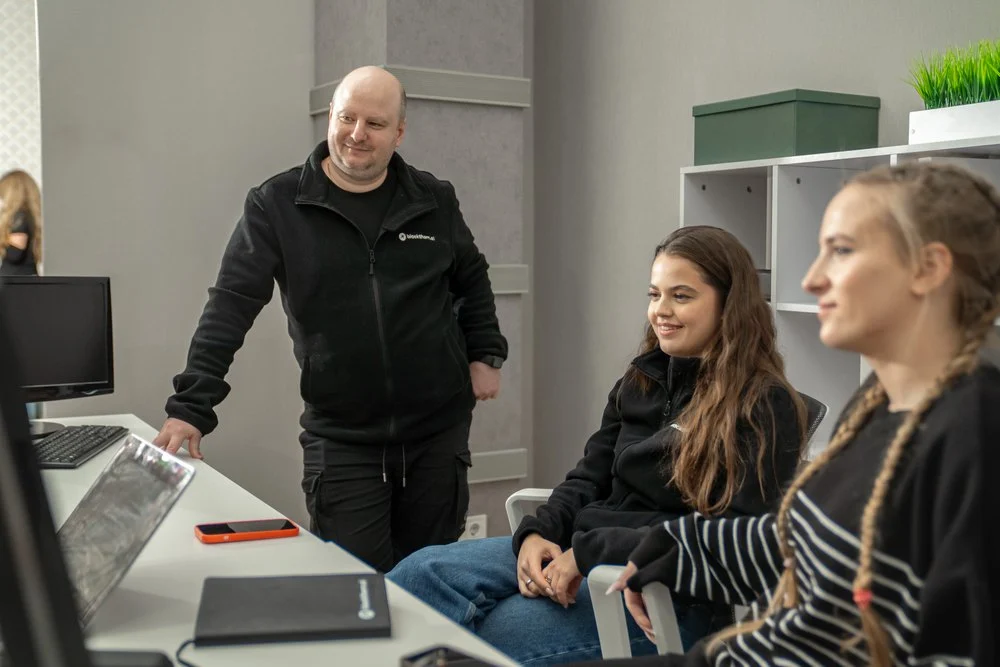
Who will run your modernization?
Each project is led by a solution architect, with data, DevOps and QA engineers joining for migration and validation. Our scientists step in when research or clinical data needs validation, statistics or a new data model. The same people can run the platform after go-live, if you choose.
- Alex Gurbych, PhD, Co-founder and Director
- Serhiy Protsenko, DrSci, Prof., Principal Data Scientist
- Dmytro Krasnienkov, PhD, Principal Scientist, Bioinformatics
- Ivan Izonin, PhD, DrSci, Scientific Advisor, Artificial Intelligence
What clients say
Feedback from teams we built for
5.0 average across 22 Clutch reviews
- Verified on Clutch
«The team surpassed expectations on timelines»
…provided much needed guidance and overall input on design, all while operating with a high degree of autonomy.
Carl Kaub, Vice President of Chemistry, HTG Molecular Diagnostics
- Verified on Clutch
«Blackthorn.ai is great at adapting to our needs»
It’s not easy to work with us as a critical infrastructure provider because we have many restrictions that make it difficult to work with data since it has to be secured.
Under NDA, Deputy, Surgical Center
- Verified on Clutch
«I was impressed by their reliable delivery and high quality of work.»
Dariya Yepikhina, Head of E-Commerce, ULTRA MODA LLC
01 What is legacy application modernization?
Updating outdated software, its code, architecture, infrastructure or data layer, so it is cheaper to run, safer and able to use cloud services and AI. At Blackthorn AI the path, from rehost to full rebuild, is decided system by system.
02 What is data modernization?
Moving data out of silos, spreadsheets and ageing databases into a governed platform, a warehouse or lakehouse with pipelines, lineage and quality checks, so analysts, reports and AI models can use it. We plan it together with the applications, because most legacy apps own the data they hold.
03 How much does application modernization cost?
The first system review costs nothing. The assessment is a fixed fee for 2 weeks: from €5,000 in Europe, £4,700 in the UK and $6,000 in other regions, excluding VAT where it applies. It ends in a 6R plan with a cost for every migration phase. Each phase then has a fixed price that you approve before it starts, and if the scope grows, we quote the change before doing it.
04 How long does a modernization project take?
The system review is a 30-minute call, with a written note within three days. The assessment takes 2 weeks. Migration starts in week 3 and puts a modernized slice into production every 8–12 weeks; the total depends on how many systems and phases the 6R plan contains. The projects behind the results on this page took from 6 to 55 weeks.
05 What does the free system review cover?
Bring one legacy system. On a 30-minute call an architect reviews its code, architecture, data, dependencies and compliance limits with you. Within three days you get a written note with the likely 6R path. The review costs nothing and doesn’t commit you to an assessment.
06 Rehost, refactor or rebuild: how do you decide?
In the assessment we score every system on business value, technical health and risk, then assign one path to each: rehost, refactor, re-architect, rebuild, retain or retire. The 6R plan shows the path, cost and risk for every system, so you can see why each one was chosen before any code moves.
07 How do you modernize validated GxP systems?
In increments, with your validation strategy written into the plan. Every release goes through regression and performance checks and ships with test and traceability records your QA can sign off, so GxP, 21 CFR Part 11, IEC 62304 or HIPAA requirements are kept. The evidence supports your validation; it is not a certificate.
08 Does the old system keep running during migration?
Yes. We move one slice at a time behind the running system, so there is no big-bang cut-over. The legacy system is retired only after the new one is proven in production, and you decide when.
09 How is modernization different from AI Transformation?
Modernization fixes the base: it moves core apps and data to a modern, cloud-native platform, with a fixed-fee assessment and a fixed price per migration phase. AI Transformation puts one AI workflow at a time into production on a monthly subscription, from €5,500 a month (£5,100 or $6,500) on a 12-month term. Modernized data and APIs plug straight into AI Transformation when you are ready.
10 Which clouds and tech stacks do you work with?
We migrate to AWS, Azure or GCP, with containers, CI/CD and infrastructure as code, and build data platforms as a warehouse or lakehouse with governed pipelines. The target stack is chosen in the assessment, from what your team can run and what your compliance rules allow.
11 How do you get our data ready for AI?
We move it to a governed platform with pipelines, lineage and quality checks, and design the data model and APIs for models, agents and retrieval-augmented generation (RAG) from the start. When research or clinical data moves, our scientists validate it and check the statistics. If you first need to pick the AI use case, AI Consulting is the place to start.
12 Should we rewrite in-house or bring in a partner?
An in-house rewrite keeps the knowledge in your team, but it often freezes the roadmap for months and ends in a big-bang cut-over. A partner adds architects and data, DevOps and QA engineers for the migration while your team keeps shipping. With us you keep the code, documents and infrastructure as code, so your team can run the platform without us.
13 Can an agency or integrator resell your modernization work?
Yes. Agencies and integrators can bring us in for the assessment or for migration phases under their own brand and contract. Book a call to agree the scope, the price and how we appear to your client.
Start with one legacy system and a 30-minute call
Tell us which system slows you down. We review it on the call and send a written note with the likely 6R path within three days.