Applied research
Reliability checks for
molecular prediction in drug discovery
In a molecular model reliability check, we apply methods from the published research on reliability-gated molecular prediction to your property, affinity, yield or response model: we test it on chemistry or biology held out from training, then set an accept-or-abstain gate and report its held-out precision and coverage. A gated model returns a prediction only when it can be shown to be operating within the conditions it was validated for, and abstains or escalates otherwise.
The method is public and free to reuse: read the preprint (not peer reviewed) or the MIT-licensed code. The first step is a reliability check of one model and one endpoint; price on request.
- AbstainWhen the model can’t be shown to be within the conditions it was validated for
- 4Model sources: in-house, vendor, platform or open source
- 8Held-out tests in the public preprint
- MITLicensed reference code, public data only
Who it’s for
When should you check a molecular model? Before its scores decide what gets made
A check is worth running when a model’s scores decide what gets made or tested, and nobody has measured them on chemistry the model has not seen. Some models offer uncertainty quantification; the check tests whether a threshold on it holds on new chemistry, whoever built the model.
- 01
Your model meets new chemistry
It scored well on a random split, and your chemists are moving into a new series. We test it on held-out chemistry and show where it stops holding.
How the check works - 02
You rely on someone else’s scores
You choose what to make from vendor, CRO or platform predictions with no stated operating limits. We check them against your measurements and set when to abstain.
Models we can check
In brief
What do you get from a reliability check?
A reliability check shows you whether, and how far, the model’s error grows on chemistry it has not seen, measured as the gap between random-split and held-out error, and where the model stops holding. A gate build then adds a calibrated accept-or-abstain threshold and an operating-limits card with its held-out precision and coverage, which your scientists can read, check and challenge.
Best for
Drug-discovery teams, in the United States and elsewhere, whose choice of what to make or test rests on a molecular model, built in-house or bought in.
You walk away with
From the check: the gap between random-split and held-out error, and the chemistry where the model stops holding. From a gate build: a calibrated accept-or-abstain threshold and an operating-limits card with its precision and coverage.
First step
A reliability check of one model, one endpoint and one context of use, scoped with you on the first call.
Budget
On request. We quote after the first call, once we know the model, the data and the decision it supports.
Is it the right fit?
Is a reliability check right for your model?
It fits when a model’s predictions feed a decision about what to make or test, and you have, or can get, measured data for chemistry the model has not seen. If you need new molecules designed, or no measurements exist to test against, start elsewhere.
It fits if
- A model’s predictions decide which molecules or reactions your team makes or tests next.
- The model was tested on a random split only, or you don’t know how it was tested.
- Your chemists are moving into a new series, scaffold or reagent set.
- You receive scores from a vendor, CRO or platform and need to know when to rely on them.
- You have, or can get, measured data for chemistry the model was not trained on.
Look elsewhere if
- You need new candidates designed and ranked. This check evaluates a model’s predictions; it does not design molecules.
- No measured data exist for the endpoint, so there is nothing to test the model against.
- You need a model qualified for a regulatory submission now. This is a discovery-stage check; any regulatory use needs its own context-specific validation.
- You want one accuracy figure for a slide. We report precision, coverage and the cases where the model fails.
- Your need is general AI or software work rather than a molecular prediction model.
Our method
How is a reliability gate built and tested?
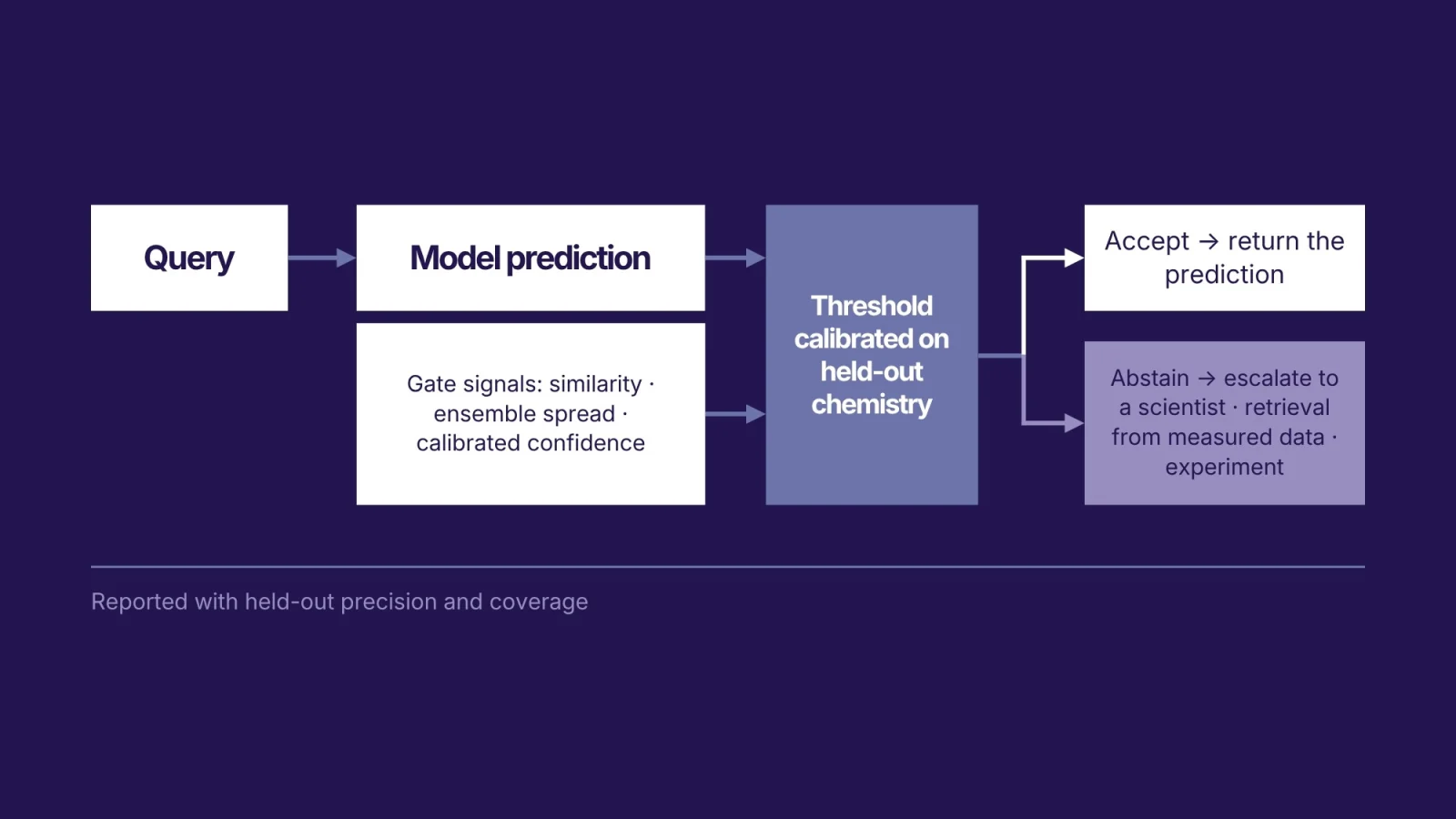
We agree what the prediction is for, split your data by chemistry, or by biological context, rather than at random, and calibrate the gate’s threshold on a held-out fold. Then we stress-test it on further held-out data and document its operating limits. The steps follow the public protocol in the preprint (not peer reviewed), with two of its six steps combined. The preprint publishes an operating-limits card for each of its public tests; the card for your model stays under your agreement, and the public protocol uses no sponsor’s data.
- 01
Define the context of use
Agree the decision the model supports, the endpoint, the chemistry in scope and the error that decision can tolerate. Define what counts as a correct prediction.
You get a written context of use and a definition of a correct prediction.
- 02
Split by chemistry
Hold out scaffolds, clusters or unseen reagents instead of random rows, and for response models cell lines or perturbations. Measure the gap between random-split and held-out error.
You get the gap, and the chemistry where the model stops holding.
- 03
Calibrate the gate
Score each query by its similarity to the training data and by ensemble spread, the two kinds of signal in the public protocol, and add the model’s calibrated confidence where it provides one. Set the threshold on a fold held out by chemistry or biology, to a target precision.
You get a threshold, the precision it targets and the coverage it costs.
- 04
Stress-test the gate
Run the gate on further held-out sets. Record precision, coverage and every case where it misses its target.
You get measured precision and coverage, failure cases included.
- 05
Document the limits
Document the thresholds and limits, and agree the abstention route: escalate to a scientist, fall back to retrieval from measured reference data, or test experimentally.
You get an operating-limits card, the abstention route and the triggers for recalibration.
Which molecular predictions can be gated?
We check and gate models for binding affinity prediction, LogP and pKa prediction, reaction yield prediction and pathway response, and generative models that propose molecules. The model can be yours, a vendor’s, a platform’s or open source. The public preprint (not peer reviewed) tested the gate on logP and reaction-yield models. For other model types the same protocol is applied and tested on your data, and the check reports where it holds.
- Binding affinity
- Test how predicted binding holds up on ligands or targets held out from training.
- LogP and pKa
- Check these and other physico-chemical predictions on scaffolds the model has not seen, such as fluorinated series.
- Reaction outcomes
- Gate yield and synthesis-success predictions for reactions with new additives, ligands or mechanisms before bench work is planned.
- Generated molecules
- Check whether a generative model’s output lies inside the conditions it was validated for. If not, fall back to retrieval from measured reference samples, or abstain.
- Pathway response
- Set the envelope on the chemistry and on the biological context, such as held-out cell lines or perturbations.
- Bought-in predictions
- Check vendor, CRO or platform scores against your measurements and set when to rely on them.
What you receive
We agree the files and formats with your team before work starts.
- Held-out reportRandom-split against held-out error, by chemistry, with the failure cases named.
- Gate settingsSignals, threshold and calibration fold, documented so your team can reproduce them.
- Operating-limits cardContext of use, target and achieved precision, coverage and known limits.
- Abstention routeWhere the queries the gate does not accept go, and who acts on them.
What should you bring to a reliability check?
Bring the model or its predictions, the measured data you can share and a plain statement of the decision the prediction supports. Tell us what the model was trained on, so we can split by chemistry, and how your data may be shared.
- The model or its predictions
- Access to the model, or its predictions on an agreed set: in-house, vendor, platform or open source.
- Measured data
- Measured values for the endpoint, including compounds or reactions outside the training set.
- Training-set description
- What the model was trained on, or the structures themselves, so similarity can be measured.
- The decision
- What the prediction decides, and how much error that decision can tolerate.
- Data terms
- Your NDA and transfer terms. Your data and models stay under your agreement.
What has been published on this method?
AI research for drug discovery: we develop, validate and publish methods that predict which molecules will work, and when to trust those predictions. The gate’s protocol is public in a 2026 ChemRxiv preprint (not peer reviewed) with MIT-licensed code, and the preprint reports all four of its pre-specified hypotheses as failed. Four earlier peer-reviewed papers, from 2021 to 2025, cover binding-affinity, reaction-yield, LogP and pKa prediction; the 2021, 2022 and 2023 studies came out of the R&D group at SoftServe, Alex Gurbych’s employer when that work was done.
| Title | Year | Venue | What it showed | DOI or link |
|---|---|---|---|---|
| Accept or abstain? A pre-specified test of reliability gates calibrated on held-out chemistry for molecular property and reaction-yield models | 2026 | ChemRxiv, preprint, not peer reviewed (CC BY 4.0) | On public logP and reaction-yield data, the calibration fold mattered most for yields. All four pre-specified hypotheses failed. | 10.26434/chemrxiv.15011706/v1 |
| accept-or-abstain (reference implementation) | 2026 | GitHub, MIT licence | Code, the analysis plan and the complete results, on public data only. | github.com/blackthorn-ai/accept-or-abstain |
| Filling the gap in LogP and pKa evaluation for saturated fluorine-containing derivatives with machine learning | 2025 | Journal of Computational Chemistry | Crippen LogP and three pre-trained graph neural networks, used as published, were inapplicable to these compounds (held-out R² −0.32, and −3.9 to −6.9); the best published model used as-is reached 0.68. Models trained from scratch on the new measurements reached R² 0.93. The measured data, code and trained models are public, on GitHub, as the PyPI package fluoriclogppka, on conda-forge and as KNIME ‘Chem AI’ nodes. | 10.1002/jcc.70002 |
| Advancing molecular graphs with descriptors for the prediction of chemical reaction yields | 2023 | Journal of Computational Chemistry | Accuracy was 70–73% on reaction mechanisms seen in training and 40–68% when each mechanism was held out in turn (40–44% on the three least similar). Code released by SoftServe (github.com/SoftServeInc/yield-paper). | 10.1002/jcc.27016 |
| Complex machine learning model needs complex testing: Examining predictability of molecular binding affinity by a graph neural network | 2022 | Journal of Computational Chemistry | R² 0.50 on a random split, 0.37 on a time split, 0.34 with unseen proteins and 0.11 on the hardest ligand-cluster split. Co-authored at SoftServe. | 10.1002/jcc.26831 |
| Ensembling machine learning models to boost molecular affinity prediction | 2021 | Computational Biology and Chemistry | A unanimous vote of six models kept 507 of 1,097 true actives at a precision of 0.95. Co-authored at SoftServe. | 10.1016/j.compbiolchem.2021.107529 |
How much does a reliability check cost?
The protocol, the code and the results on public data are free to use under their licences (CC BY 4.0 for the preprint, which is not peer reviewed, and MIT for the code). What is priced is applying them to your model and data: pricing is on request, and we agree scope and fee with you on the first call, before work starts. A gate build and later recalibration are quoted from what the check finds.
Reliability check
On request
One model, one endpoint and one context of use. Held-out splits by chemistry, the gap between random-split and held-out error, and where the model leaves its envelope.
The first step · scope agreed upfront
Gate build and calibration
On request
Gate signals and a threshold calibrated on held-out chemistry to a target precision, with the coverage it costs, stress-tested and documented in an operating-limits card.
Quoted from the reliability check
Recalibration as chemistry moves
On request
Re-test the gate and re-set thresholds when a new series or new assay data arrive, so the stated limits stay current.
Quoted when new series or assay data arrive
Budget separately for any new measurements or synthesis your team commissions.
The published method uses public data only. Your data and models stay under your agreement.
What did the published tests show?
The published tests show how much the split matters: in a 2022 binding-affinity study Alex Gurbych co-authored at SoftServe, R² fell from 0.50 on a random split to 0.11 on the hardest ligand-cluster split. In the public preprint, which is not peer reviewed, where the gate was calibrated mattered most for reaction yields. All four pre-specified hypotheses failed their success criteria. It is a first public test, reported in full with its limits, not proof that the gate works on every model; its practical recommendation is to calibrate abstention thresholds on data held out by chemistry and to publish the coverage and precision achieved on held-out tests, not on random ones.
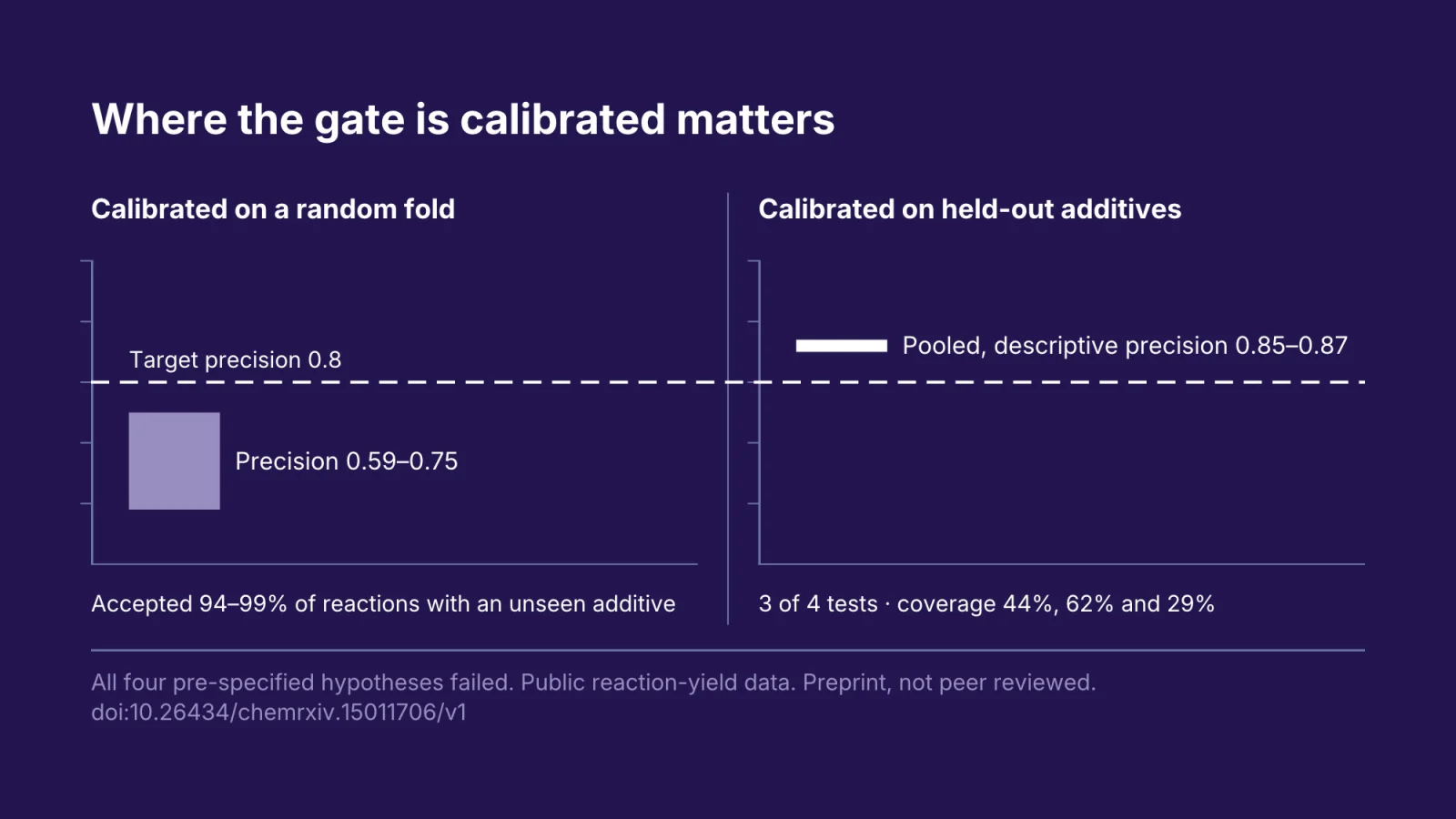
- 0.85–0.87Pooled, descriptive precision after held-out calibration, 3 of 4 testsChemRxiv preprint, 2026 · not peer reviewed
Where the gate is calibrated matters
At a target precision of 0.8, gates calibrated on a random fold accepted 94–99% of reactions with an unseen additive, at a precision of 0.59–0.75. Calibrated on held-out additives, they reached a pooled, descriptive precision of 0.85–0.87 on three of the four tests, at coverage of 44%, 62% and 29%. All four pre-specified hypotheses failed. Read the preprint →
- 0.49 → 0.29Error rate without the gate, then on the top 30% by gate score (held-out logP clusters)ChemRxiv preprint, 2026 · not peer reviewed
Ranking by the gate’s score lowered errors
Ranking queries by the gate’s score lowered the error rate at 30% coverage by 0.16–0.35 on seven of the eight held-out tests. On a fluorinated-compound hold-out it ranked errors no better than chance at 30% coverage. All four pre-specified hypotheses failed. Read the preprint →
- 0.50 → 0.11R², random split against the hardest ligand-cluster splitJournal of Computational Chemistry, 2022
Random splits overstate generalisation
A binding-affinity graph network explained R² 0.50 under a random split and 0.11 on the hardest ligand-cluster split, in a 2022 study Alex Gurbych co-authored at SoftServe. Read the paper →
- 507 of 1,097True actives kept, at a precision of 0.95Computational Biology and Chemistry, 2021
Abstaining costs coverage
A unanimous vote of six models kept about half of the true actives in return for a precision of 0.95, a simple form of the precision–coverage trade-off. The study was co-authored at SoftServe. Read the paper →
Should you rely on built-in uncertainty, a platform, an in-house build or a held-out reliability check?
Built-in estimates suit queries close to the training data; a held-out reliability check suits decisions that rest on chemistry the model has not seen. Some models and platforms estimate uncertainty or flag an applicability domain, but those estimates are rarely checked on new chemistry, so the open question is whether a threshold on them still holds there.
| Criterion | A held-out reliability check | The model’s built-in uncertainty | A commercial platform | Build it in-house |
|---|---|---|---|---|
| Best fit | Decisions that rest on predictions for chemistry the model has not seen. | Queries close to the data the model was trained and validated on. | Teams that work within the models and workflows the platform supports. | Teams with the staff and data to run held-out tests on every model. |
| What does it report? | From the check: random-split against held-out error, with the failure cases. From a gate build: held-out precision and coverage at a stated threshold. | A per-prediction uncertainty or interval, as the model’s authors define it. | Uncertainty estimates or domain flags, as the vendor defines them. | Whatever your team chooses to measure and maintain. |
| Where is the threshold tested? | In the gate build: calibrated on a fold held out by chemistry or biology to a target precision you agree, then stress-tested on further held-out data. | Depends on the model: check which split it was calibrated on. | Depends on the vendor’s method: ask how it was tested on new series. | On the splits your team designs. |
| Which models does it cover? | In-house, vendor, platform or open-source models. | The model that produces it. | The models the platform supports. | The models your team maintains. |
| How do you start? | A reliability check of one model, one endpoint and one context of use. | Read how the uncertainty was calibrated, and on which data. | Test its flags on your own held-out chemistry before relying on them. | Start from the public protocol and MIT-licensed code, assemble held-out data and run the tests yourselves. |
Why check a model against a published method?
Your scientists should see how a threshold was set before it decides what gets made. The research aims to move from returning a prediction for every query to reporting a prediction or abstention under stated operating criteria, together with held-out precision and coverage. The method behind this check is public, with its code and its failed hypotheses, so your team can inspect the protocol and challenge the result.
- Set before results. The hypotheses and their success criteria were set before the evaluation, and the preprint, which is not peer reviewed, reports all four pre-specified hypotheses as failed.
- Free to reuse. The published method is developed on public data, separately from sponsor deliverables, and its reference implementation is MIT-licensed, so any laboratory can inspect it and apply it without licensing anything from us.
- Held out, not random. Thresholds are calibrated and stress-tested on data held out by chemistry or biology, because random splits overstate performance.
- Established parts, tested together. Ensembles, nearest-neighbour similarity, conformal calibration and out-of-distribution scores are established tools, and selective prediction, in which a model accepts or abstains, is an established idea. The work is developing and testing how to combine and calibrate them on chemistry the model has not seen, and publishing the protocol with its code.
Dr. Oleksandr (Alex) Gurbych
- Co-founder and Director, Blackthorn AI
- PhD in Computer Sciences, Lviv Polytechnic National University (2023)
He leads the research behind this check. He posted the accept-or-abstain preprint (not peer reviewed) with its reference code, and is corresponding author of peer-reviewed papers on reaction-yield and on LogP and pKa prediction.
What is reliability-gated molecular prediction, and what does a reliability check not claim?
Reliability-gated molecular prediction: developing, validating and publishing artificial-intelligence methods that generate and evaluate candidate drug molecules and return each prediction only when the model can be shown to be operating within the conditions it was validated for. That is a research programme with two inseparable halves: prediction, including the generation of candidates, and validation and reliability, the half that distinguishes it. Its methods are published in peer-reviewed papers and a public preprint (not peer reviewed) with code, and the preprint uses no sponsor’s data, code or results. A reliability check applies the validation-and-reliability methods to one model at a time. It makes no regulatory claim, reports precision only as measured on held-out data and does not replace experiments.
- Not a regulatory claim. This is a discovery-stage check, and it does not make a model ready for an FDA submission. It reports evidence in terms the FDA–EMA guiding principles of January 2026 use, such as context of use, so that a sponsor can build on it in its own later validation; it claims no compliance with them.
- Not a replacement for experiments. These methods support experimental decisions. They do not determine in advance that a molecule will become a safe and effective medicine.
- Not a guarantee. Precision is measured on held-out chemistry and can fall on chemistry that differs again. The threshold rule’s guarantee is approximate and covers only queries like the calibration data, so none is claimed for new chemistry.
- Molecular models only. This check covers models that predict molecular properties, binding, reaction outcomes or biological response, and models that generate molecules, and nothing broader. Blackthorn AI’s other software and AI services are separate offerings and are not part of this check.
- Your data stays under your agreement. The published method uses public data only. Sponsors’ data and sponsor-specific models remain subject to their agreements.
FAQ
What else should you know before a reliability check?
These answers cover how the gate works, what it costs in coverage, what you receive and what the method does not claim. Every figure comes from a public paper or the public preprint, which is not peer reviewed.
01 What is reliability-gated molecular prediction?
Reliability-gated molecular prediction: developing, validating and publishing artificial-intelligence methods that generate and evaluate candidate drug molecules and return each prediction only when the model can be shown to be operating within the conditions it was validated for. In practice, a gate accepts each query or abstains. The gate combines signals such as similarity to the training data, ensemble spread and calibrated confidence. Its threshold is set on data held out by chemistry or biology, and each gate is reported with its held-out precision and coverage.
02 How is this different from a model’s reported accuracy?
Reported accuracy often comes from a random split, where test molecules resemble the training set. A reliability check measures the model on chemistry held out by scaffold, cluster or reagent, closer to what a new series looks like, and a gate build reports the precision and coverage a gate achieves there. The gap can be large. In a 2022 binding-affinity study Alex Gurbych co-authored at SoftServe, R² fell from 0.50 on a random split to 0.11 on the hardest ligand-cluster split. A 2025 benchmark, BOOM, found the top model’s average out-of-distribution error about three times its in-distribution error.
03 What is an applicability domain, and why isn’t a similarity check enough for deep models?
An applicability domain is the region of chemistry, and for response models the biological context, in which a model’s predictions have been shown to meet a stated level of reliability. For deep models that predict a biological response or generate molecules, a check on the input molecule alone is not enough. The envelope has to cover the chemistry, the biological context and the calibrated confidence of the prediction, combined into one accept-or-abstain decision. The OECD principles for validating (Q)SAR models have called for “a defined domain of applicability” since 2004.
04 What happens when the gate abstains?
When the gate abstains, the model returns no prediction for that query, and the query follows a route agreed in advance. It can go to a scientist for review, fall back to retrieval from measured reference data, or be tested experimentally. The route is written into the operating-limits card. Abstaining marks where the model has not been shown to work. The share of queries the gate accepts is reported as its coverage.
05 Which kinds of models can be gated?
Gates can be built for models that predict binding affinity, physico-chemical properties such as LogP and pKa, reaction yield or synthesis success, or pathway response from transcriptomic data, and generative models that propose molecules. The model can be built in-house, bought from a vendor or platform, or open source. What matters is measured data the model has not seen, held out by chemistry or biology, so the gate can be calibrated and tested. If you have only a vendor’s predictions, we agree which gate signals are available before the check starts. The public preprint (not peer reviewed) has tested the gate on logP and reaction-yield models only.
06 How much coverage do we give up for higher precision?
It depends on the model and the chemistry, and the check measures it rather than assuming it. In the 2026 ChemRxiv preprint (not peer reviewed), at a target precision of 0.8, gates calibrated on held-out additives reached a pooled, descriptive precision of 0.85–0.87 on three of the four unseen-additive tests, at coverage of 44%, 62% and 29%. All four pre-specified hypotheses failed. In a 2021 study Alex Gurbych co-authored at SoftServe, a unanimous vote of six models kept 507 of 1,097 true actives at a precision of 0.95.
07 Isn’t conformal prediction enough on its own?
Not on its own. Conformal prediction turns a model’s errors on a calibration set into intervals with a stated coverage, which holds only when calibration and test data are exchangeable; new chemistry can break that assumption. In the 2026 ChemRxiv preprint (not peer reviewed), conformal intervals calibrated on a random fold lost coverage under shift, down to 0.64. All four pre-specified hypotheses failed. In an exploratory analysis, not in the analysis plan, intervals calibrated on the held-out fold recovered coverage on seven of eight tests, at the cost of wider intervals. Conformal calibration can feed a gate, but its threshold still has to be tested on held-out chemistry.
08 Does the gate guarantee its precision on new chemistry?
No. A gate’s precision is measured on held-out chemistry, and it can fall on chemistry that differs again. The threshold is set by a rule based on Learn-then-Test; its guarantee is approximate and covers only queries like the calibration data. In the 2026 ChemRxiv preprint (not peer reviewed), all four pre-specified hypotheses failed their success criteria. On a fluorinated-compound hold-out, the gate calibrated on held-out data missed its target. That is why the operating-limits card states where each threshold was tested, and why thresholds are re-set when the chemistry moves.
09 What do we receive at the end?
You receive an operating-limits card for each gated model: the context of use, the target precision, the precision and coverage achieved on held-out chemistry, the known failure cases and the limits of the test. You also receive the held-out report and the agreed abstention route. The gate settings, meaning the signals, the threshold and the calibration fold, are documented so your team can reproduce them. We agree file formats before work starts.
10 Do you need our proprietary data or models?
Yes, for the check itself: we need access to the model or its predictions, and measured data for chemistry the model has not seen. Nothing proprietary is needed for the first call; bring a summary, and we agree an NDA, access and a transfer method before you share proprietary structures or assay data. The published method uses public data only, and sponsors’ data and sponsor-specific models remain subject to their agreements.
11 Is the method published, and can we inspect the code?
Yes. The protocol is in a ChemRxiv preprint posted on 4 November 2026 (not peer reviewed), with an MIT-licensed reference implementation on GitHub that uses public data only. The hypotheses and their success criteria were set before the evaluation, and the preprint reports that all four failed. Four earlier peer-reviewed papers, from 2021 to 2025, cover binding-affinity, reaction-yield, LogP and pKa prediction.
12 Does this make a model FDA-ready or replace lab experiments?
No to both. These methods support experimental decisions. They do not determine in advance that a molecule will become a safe and effective medicine. The check is a discovery-stage tool and makes no regulatory claim about the model or its outputs. We report in terms such as context of use and life-cycle management from the FDA–EMA guiding principles for AI in drug development, published in January 2026, so that a sponsor can build on the evidence in its own validation, but we claim no compliance with them. Your lab still measures what matters.
13 How does an engagement start, and what does it cost?
It starts with a call about one model, one endpoint and the decision it supports. From that call we scope a reliability check and quote it. Pricing is on request, because it depends on the model, the data and the number of held-out tests, and scope and fee are agreed before work starts. A gate build and later recalibration are quoted from what the check finds. Budget separately for any new measurements your team commissions.
14 Who leads the work?
The research and each reliability check are led by Dr. Oleksandr (Alex) Gurbych, Co-founder and Director, Blackthorn AI. PhD in Computer Sciences, Lviv Polytechnic National University (2023). He posted the accept-or-abstain preprint (not peer reviewed) with its reference code, and is corresponding author of peer-reviewed papers on reaction-yield and on LogP and pKa prediction. His publications are listed on ORCID and Google Scholar.
Which model decides what you make next?
Bring the model, or its predictions, and the decision they feed. We’ll scope a reliability check on chemistry the model has not seen.