- Customer Stories
- /
- Liquid Biopsy Biomarker Analysis

Liquid Biopsy Biomarker Analysis
An independent analysis of liquid biopsy data from 573 women undergoing breast biopsy: data quality, reproducibility and validation across three lab readers.
Women analysed
at two clinical sites
Source tables joined
into one dataset
CAML count agreement,
paired tubes (ICC)
Creatv Bio develops a liquid biopsy that captures and counts rare circulating cells from a standard blood draw.
In May–June 2026, Blackthorn AI joined 10 source tables into one patient-level dataset and analysed 573 women undergoing breast biopsy at two clinical sites. We checked how well counts of cancer-associated macrophage-like cells (CAMLs) agreed between paired blood tubes (ICC 0.83) and scored the models within and across three lab readers and on unseen patients. A clinical re-analysis followed in October 2026.
Testing a biomarker’s robustness before the next study
Creatv Bio’s assay counts and sizes cancer-associated macrophage-like cells (CAMLs) and circulating tumour cells (CTCs) in a standard blood draw. In a two-site breast biopsy cohort, the team needed an independent check of how reproducible and reader-dependent those counts are before a larger study.
Reader-aware evidence, from raw tables to board-ready findings
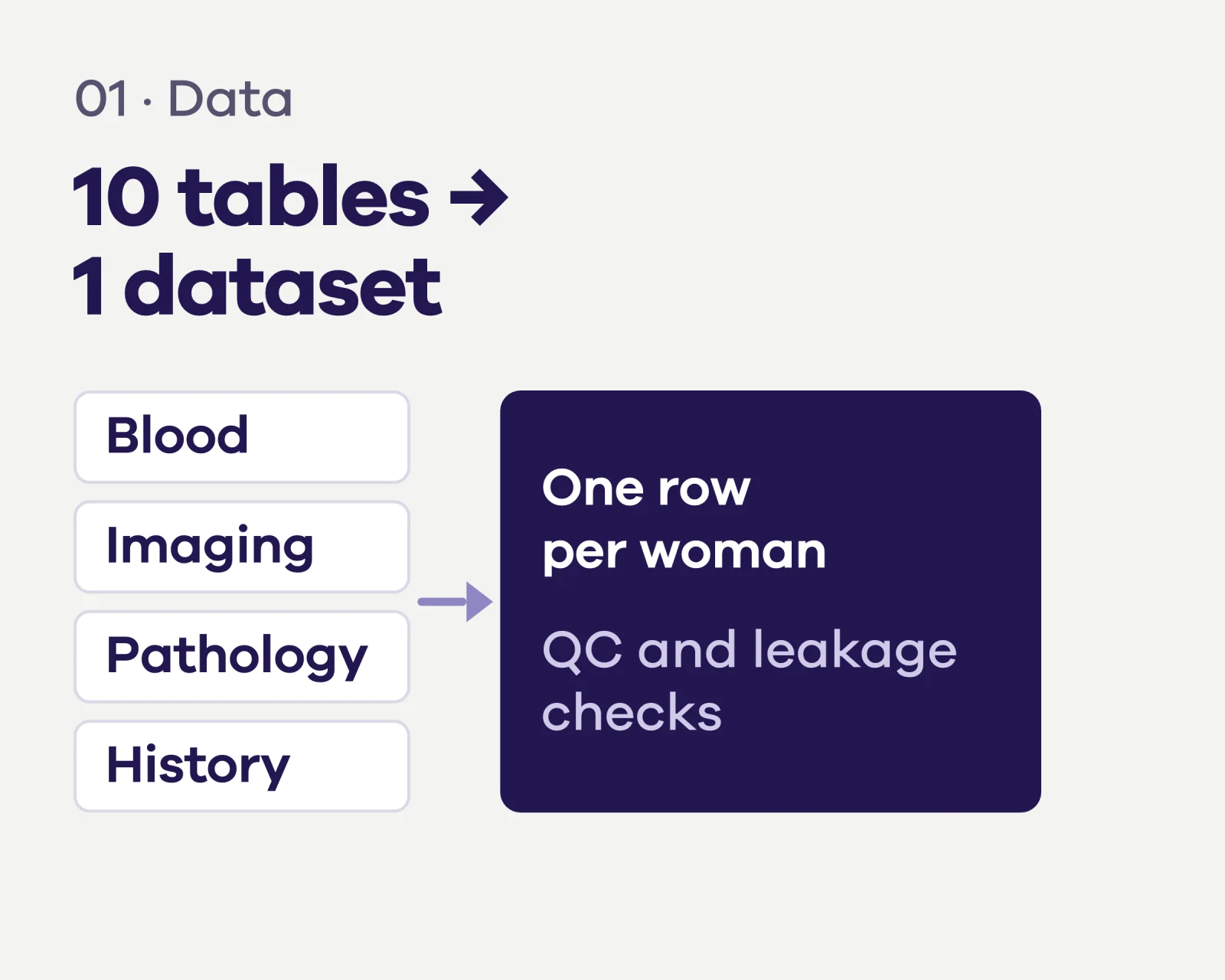
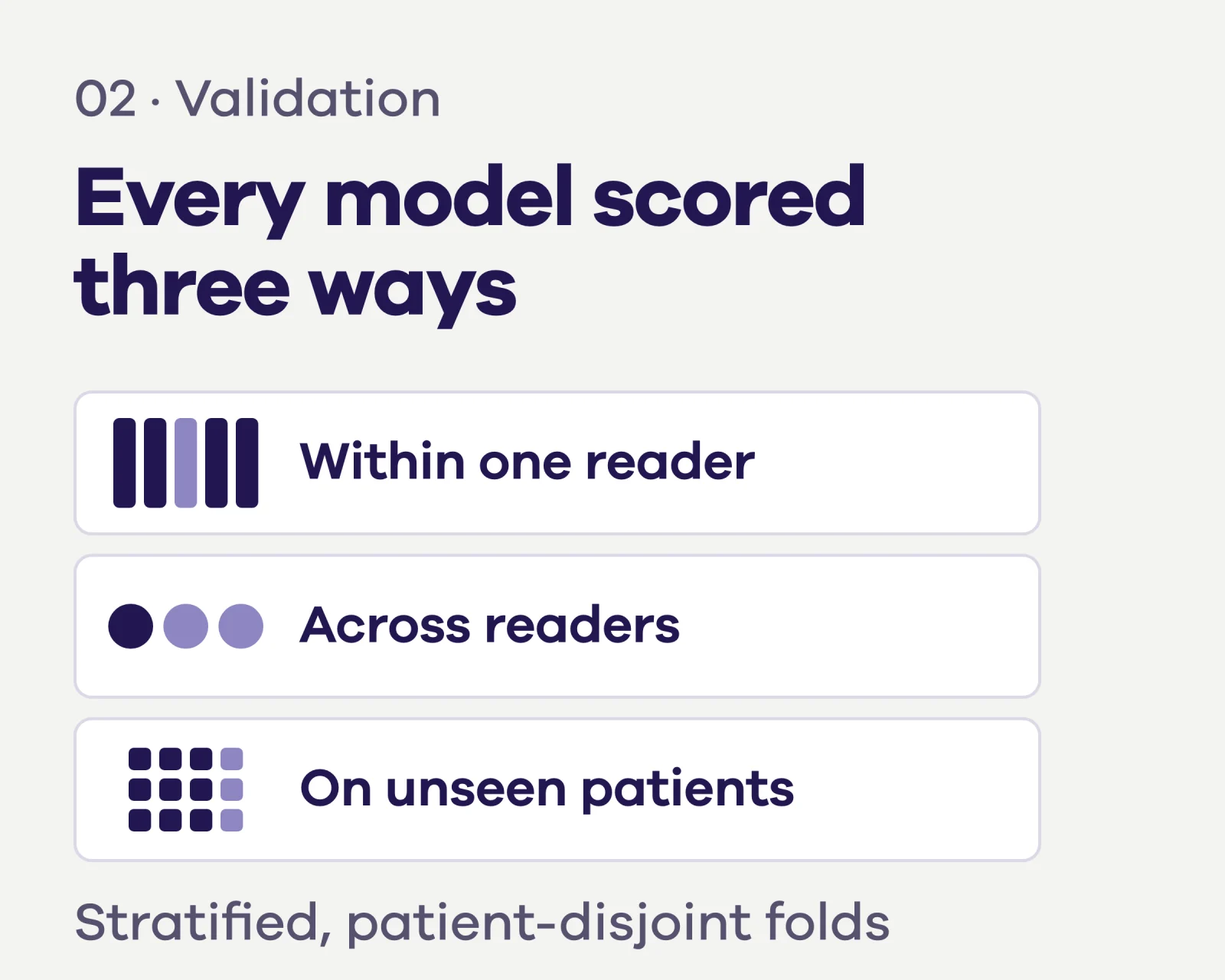
Blackthorn AI joined the cohort’s 10 source tables into one patient-level dataset with QC, a data dictionary and leakage checks. We tested every feature with multiple-testing control and compared interpretable and non-linear models: regularised regression, CatBoost, H2O AutoML and RuleFit. Each model was scored within reader, across readers and on unseen patients, explained with SHAP and cross-checked with a double machine learning analysis. In October 2026, a clinical re-analysis related marker levels to tumour size and BMI and outlined a validation study.
Built in Python with pandas, scikit-learn, CatBoost, H2O AutoML and RuleFit, with SHAP to explain the models.




Project duration
Initial engagement: six weeks, May–June 2026. Clinical re-analysis: October 2026.
Week 1 Data intake & QC
Confirmed endpoints and label mapping, standardised patient IDs across 10 tables, and profiled missingness, outliers and leakage.
Week 2 Correlation & bias checks
Clustered redundant measures such as BMI and weight, flagged sparse features, and checked site, reader and timing effects.
Week 3 Models & validation
Ran corrected univariate tests, then compared interpretable and non-linear models with stratified, patient-disjoint validation and SHAP explanations.
Weeks 4–6 Group analysis & handover
Modelled the five ordered diagnostic groups, added a causal cross-check, and delivered the report, board deck, results tables and code.
Oct 2026 Clinical re-analysis
Related marker levels to tumour size and BMI, and outlined a validation study.
Team Size



What the Analysis Delivered
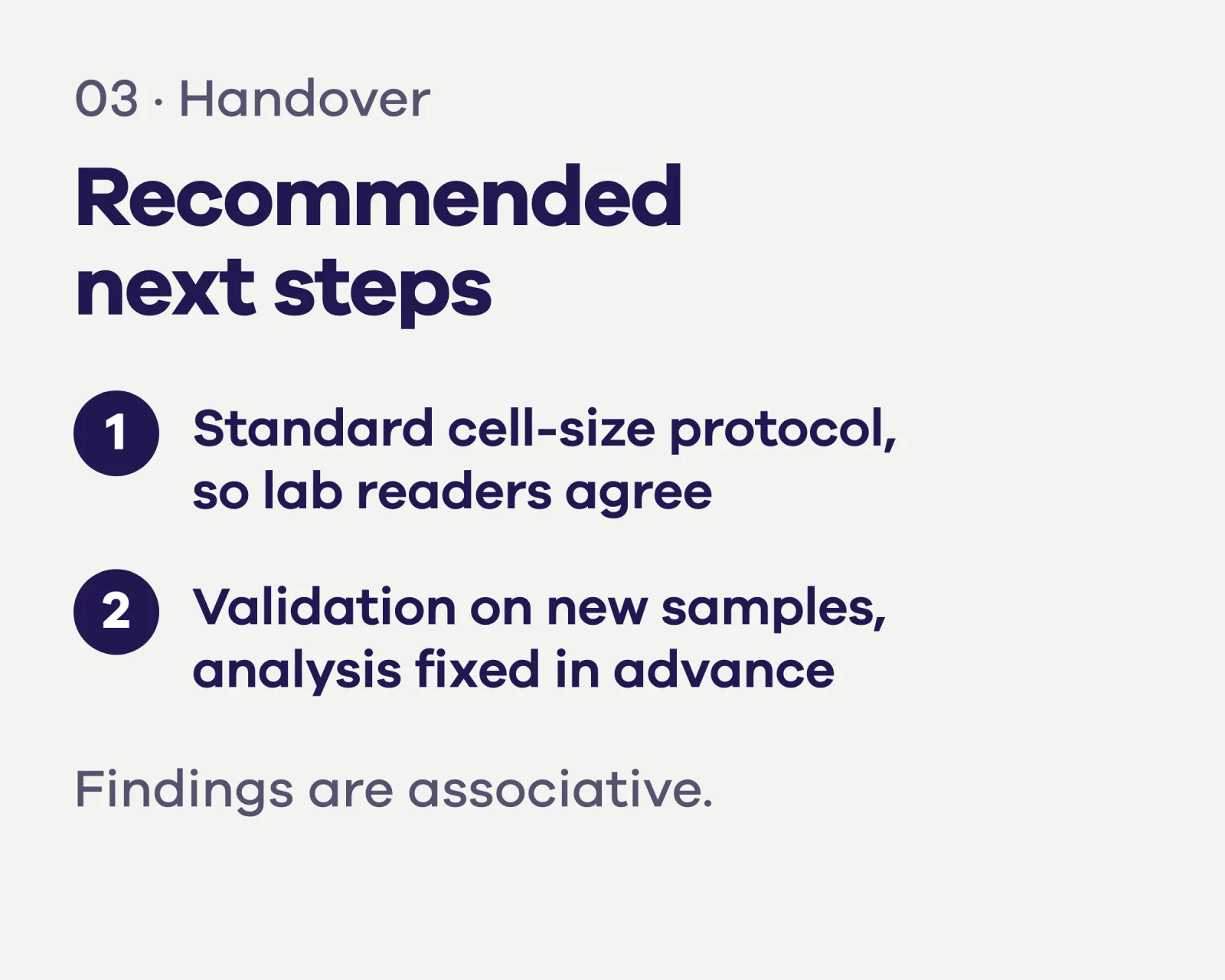
Findings are associative and come from one blood draw per woman. Validation on a new set of samples, with the analysis fixed in advance, is the recommended next step.
0.83
Tube-to-tube agreement (ICC)CAML counts from each woman’s paired tubes agreed well, supporting tube-to-tube reproducibility.
3
Lab readers, checked for biasCell-size readings differed by reader, so every model was scored within and across readers and on unseen patients.
4
Deliverables handed overReport, board deck, results tables and code.
FAQ
Questions about the Creatv Bio liquid biopsy analysis
01What are CAMLs (cancer-associated macrophage-like cells)?
Cancer-associated macrophage-like cells (CAMLs) are large, macrophage-like cells that circulate in the blood and can be captured from a standard blood draw. Scientists at Creatv MicroTech, Inc., of which Creatv Bio is a division, co-authored the 2014 PNAS paper that described them. Creatv Bio’s liquid biopsy counts and sizes CAMLs alongside circulating tumour cells (CTCs).
02What did Blackthorn AI do for Creatv Bio?
Acting as an AI-driven CRO, Blackthorn AI ran an independent biomarker data analysis of Creatv Bio’s data from a two-site breast biopsy cohort in May–June 2026, with a clinical re-analysis in October 2026. We joined 10 source tables into one patient-level dataset, analysed 573 women and delivered a written report, a board deck, results tables and the analysis code.
03How reproducible were the CAML counts?
Blood was drawn into two tubes per woman on or before the day of biopsy, so CAML counts could be compared between paired tubes. The paired counts agreed well, with an intraclass correlation coefficient (ICC) of 0.83. ICC runs from 0 to 1 and shows how well repeat measurements agree; it is not a measure of diagnostic accuracy.
04How did the analysis handle differences between lab readers?
Three lab readers measured the samples, and their cell-size readings differed. Blackthorn AI therefore scored every model three ways: within one reader’s measurements, across readers and on unseen patients. The report recommended a standard cell-size measurement protocol before the next study.
05Which statistical and machine learning methods were used?
Each blood feature was tested with multiple-testing control. Blackthorn AI then compared interpretable and non-linear models (regularised regression, CatBoost, H2O AutoML and RuleFit) and explained them with SHAP. A double machine learning analysis, which adjusts for confounders, was added as a cross-check. Validation was stratified, because there was about one cancer for every four benign results, and patient-disjoint, so a woman’s two tubes never sat in both training and test data.
06What next steps did Blackthorn AI recommend?
A standard protocol for measuring cell size, so that lab readers agree, and validation on a new set of samples with the analysis fixed in advance. The current findings are associative and come from one blood draw per woman.