Patient Check-in and Cloud Engineering for a Telemedicine Platform
Online pre-check-in and self check-in apps for a Canadian imaging network, connected to the clinic RIS over HL7 FHIR R4, plus managed Azure, Terraform and CI/CD for its telemedicine platform.
From kickoff to the core pre-check-in and self check-in apps on Azure
RIS integration, tested against the vendor’s production server
Visited in on-site discovery, 12 front-desk and imaging staff interviewed
A Canadian imaging network runs its own telemedicine platform: we built its patient check-in, connected it to the clinic RIS and moved the platform onto managed Azure.
A Canadian imaging network runs a patient–physician platform: after an exam, patients find their reports and images in their account, share them with their doctor and book video consultations. In 2024 we started work on that platform: first a clinic workflow study and the check-in apps, then infrastructure, CI/CD and QA inside the client’s product team.
Industry
Custom Software Development, Healthcare Integrations, Cloud & DevOps, Team Extension
Services
Canada
Location
Custom software · Cloud & DevOps · Team extension
Engagement
Overloaded front desks and a platform that had outgrown its first architecture
Front desks were overloaded. In our on-site study, walk-in patients shared one queue with booked patients and took several times longer to register, and technologists filled in intake questionnaires by hand before first exams. Patients repeated the same details and paperwork at every visit. The platform had outgrown its first architecture: front end and back end were tightly coupled, the database ran on a single virtual machine and video calls ran on fixed servers. Every change had to meet Canadian health-privacy rules and work with the clinics’ existing RIS through a vendor API that was still being built.
Pre-check-in, self check-in and RIS integration on Azure
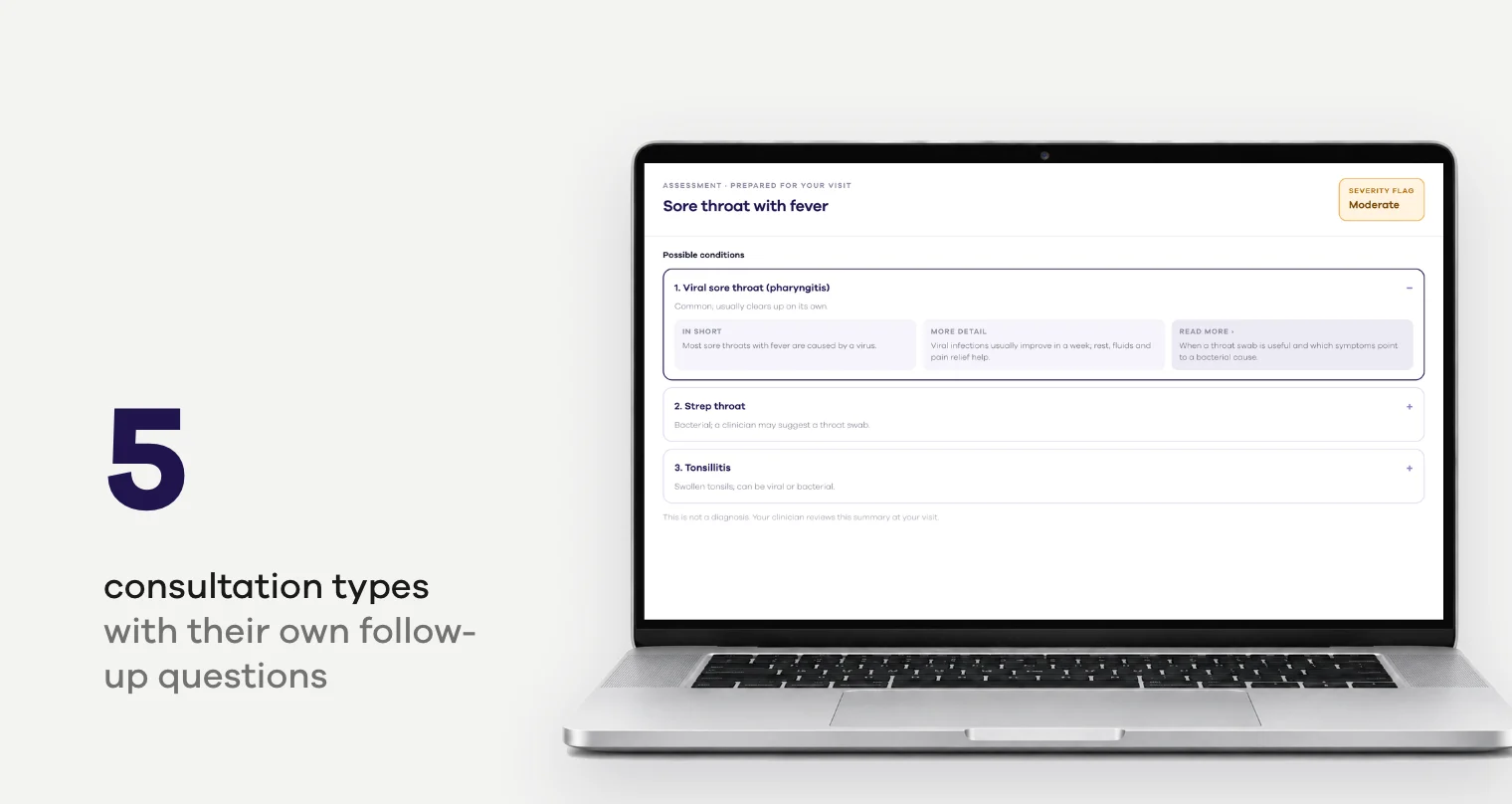
We built pre-check-in so patients can check in and complete intake questionnaires on their phone before the visit, added a self check-in app for the clinic, and connected both to the clinic RIS over HL7 FHIR R4. In parallel we moved the platform’s database and deployments to managed Azure with Terraform and GitLab CI/CD, and later joined the client’s product team.
What we delivered
Discovery in the clinics
We visited three clinics and interviewed receptionists and mammography and ultrasound technologists, mapping each step from arrival to report. The study produced a prioritised backlog: move check-in and intake questionnaires out of the waiting room and onto the patient’s phone.
Pre-check-in
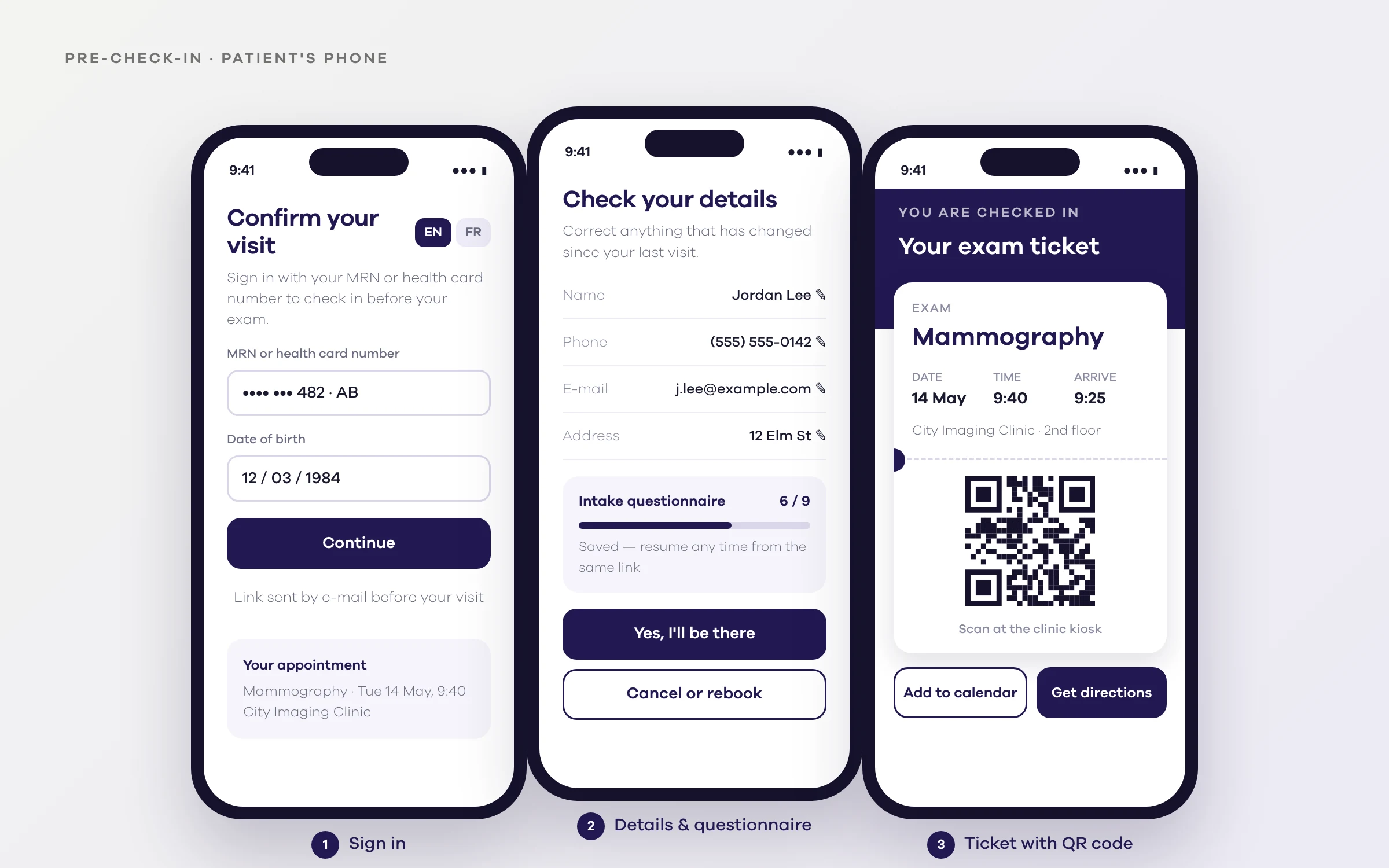
Before the visit, patients get an email link, sign in with their MRN or health card number, check and correct their details, confirm or cancel, and complete the intake questionnaire for mammography or bone density — resuming from the same link if they stop. They receive a boarding-pass style ticket with a QR code, a calendar file and directions, in English or French.
Self check-in at the clinic
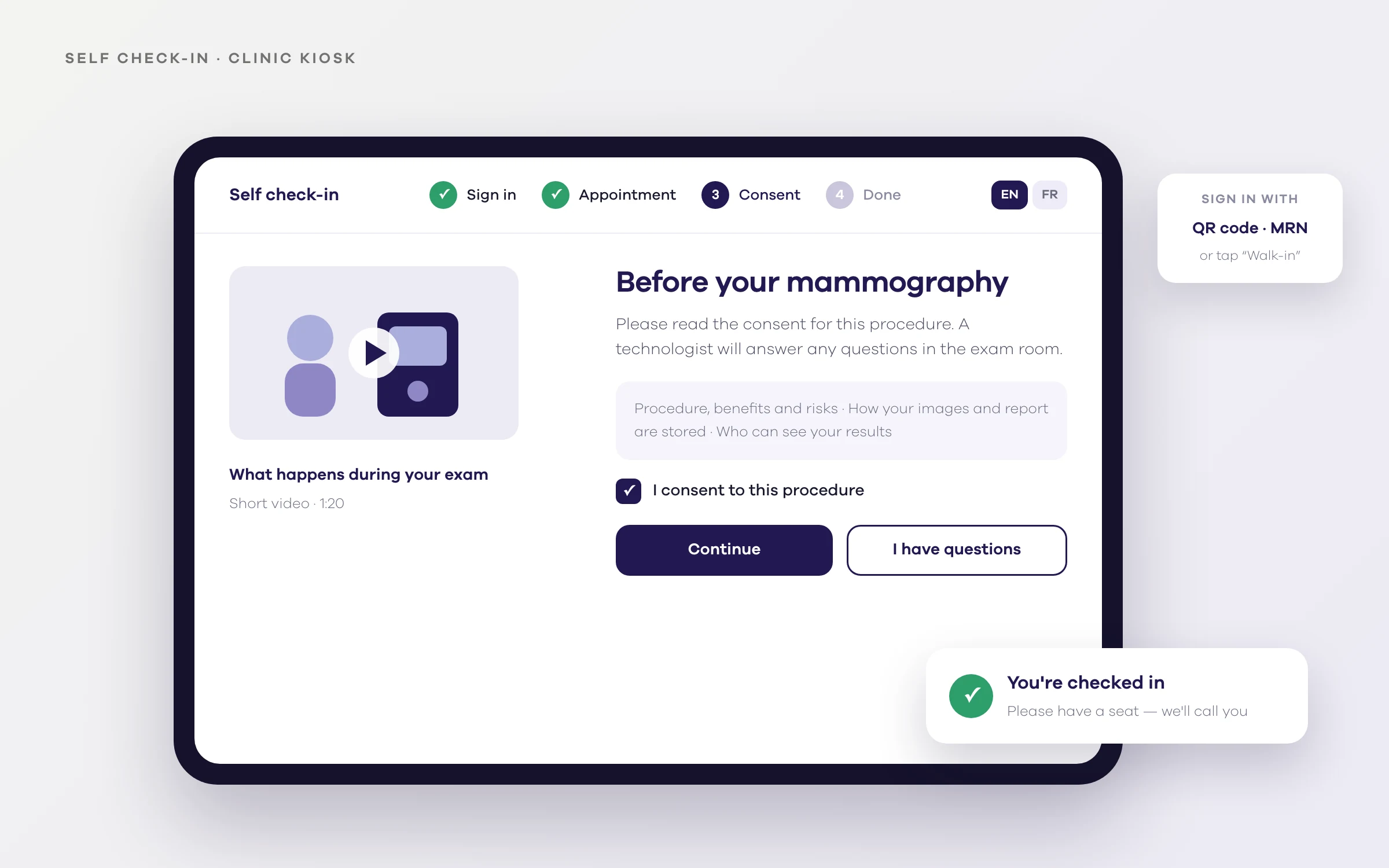
A self check-in app signs patients in by QR code or MRN, handles walk-ins, records procedure-specific consent, shows short educational cartoons about the exam and confirms they are checked in.
RIS integration over HL7 FHIR R4
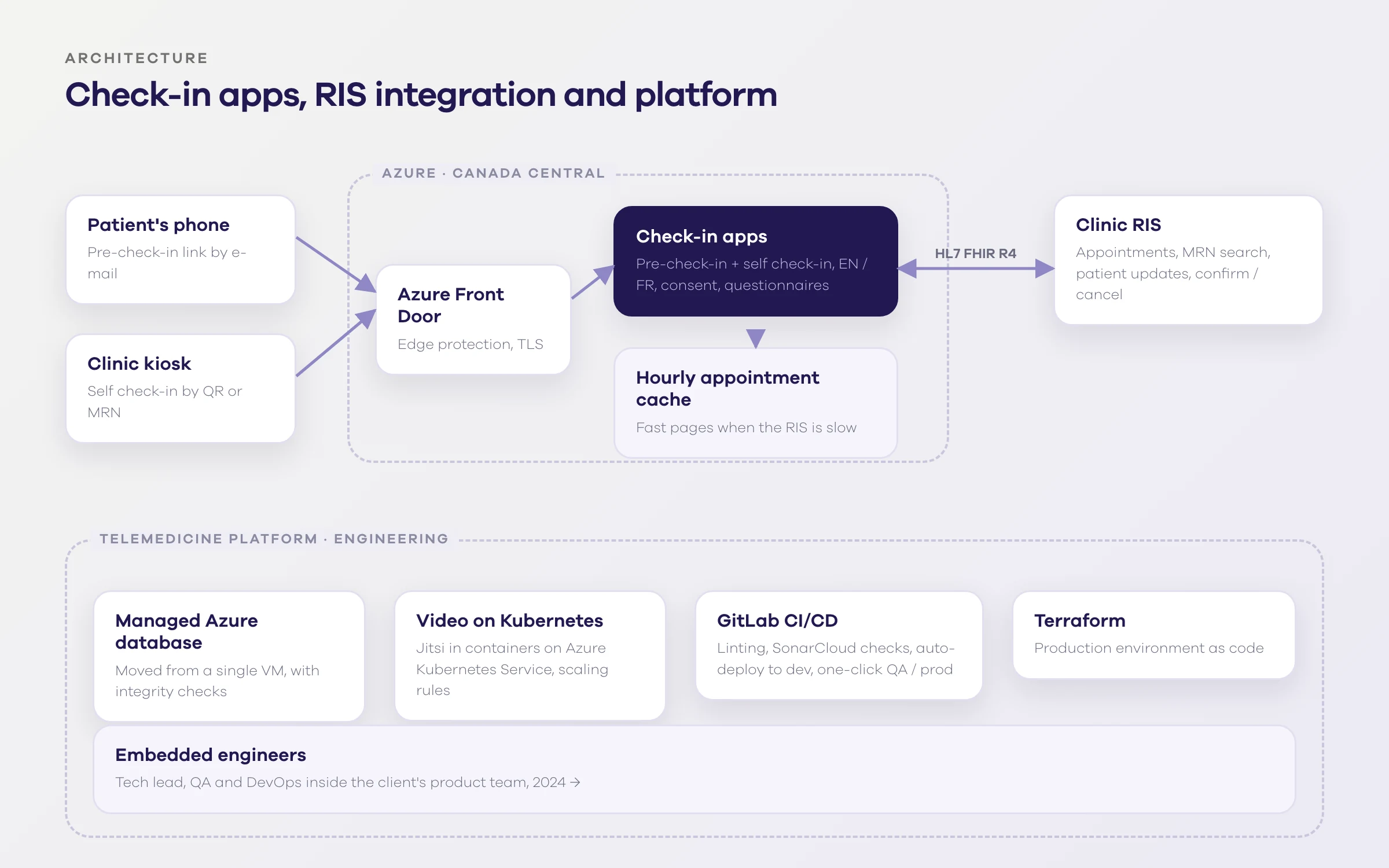
We integrated both apps with the clinics’ RIS through its HL7 FHIR R4 API — appointment lookup, MRN search, patient updates, confirmation and cancellation — with an hourly cache for when the RIS is slow. The integration passed testing against the vendor’s production FHIR server in January 2025.
Cloud and delivery pipeline
We instrumented and load-tested the platform API, moved its database from a virtual machine to a managed Azure database with integrity checks, cleaned up the API’s HTTP methods, wrote the production environment in Terraform and set up GitLab CI/CD with linting, SonarCloud checks, automatic deploys to dev and one-click releases to QA and production.
Video calls on Kubernetes
We moved the Jitsi video stack into containers on Azure Kubernetes Service with scaling rules, so call capacity is no longer fixed by one server.
Security for the check-in apps
Hosted in Azure’s Canada Central region behind Azure Front Door, with secure login configuration, encryption in transit and at rest, intrusion detection, and patient data cleared from the apps when a session ends.
Inside the product team
From September 2024 our tech lead, QA engineer and DevOps engineer worked inside the client’s product team, under its management, on QA, CI/CD and Azure infrastructure. Our DevOps engineer still supports the platform in 2026. We also built the platform’s AI symptom triage assistant.
The stack we worked in: Azure, Terraform and Kubernetes
Azure Kubernetes Service, Front Door, Container Registry, Communication Services and a managed database on Microsoft Azure, Terraform for the production environment, GitLab CI/CD with SonarCloud checks, Docker, Jitsi for video, and HL7 FHIR R4 for the RIS. The client’s platform itself runs on Laravel, React and an OHIF-based DICOM viewer.







Project duration
From clinic discovery in February 2024 to DevOps support in 2026.
Team Size
What the Engagement Delivered
Delivery milestones from the project records. Our engineers have worked inside the client’s product team since 2024, and DevOps support continues in 2026.
Our core pre-check-in and self check-in apps took about ten weeks, with the clinic system mocked. Connecting to the RIS took longer because it depended on the vendor’s API, so plan the timeline around the integration, not the screens.
Yes, if the RIS exposes an API. We used the RIS’s HL7 FHIR R4 API to look up appointments, search by MRN, update patient details and confirm or cancel visits, with an hourly cache for speed.
We moved the Jitsi video stack into containers on Azure Kubernetes Service with scaling rules, so call capacity grows with the number of calls instead of being fixed by one server. Recording needs its own scaling plan.
The check-in apps were built for PIPEDA requirements: hosted in Azure’s Canada Central region behind Azure Front Door, encryption in transit and at rest, procedure-specific consent, and patient data cleared when a session ends. Formal compliance sign-off stays with the clinic.
Yes. From late 2024 our tech lead, QA and DevOps engineers worked inside the client’s own team and backlog, under the client’s management; our DevOps engineer still supports the platform today.