AI Symptom Triage Assistant for Telemedicine
An AI assistant that interviews patients before a virtual visit, rates how severe their symptoms are and returns a structured assessment with plain-language explanations.
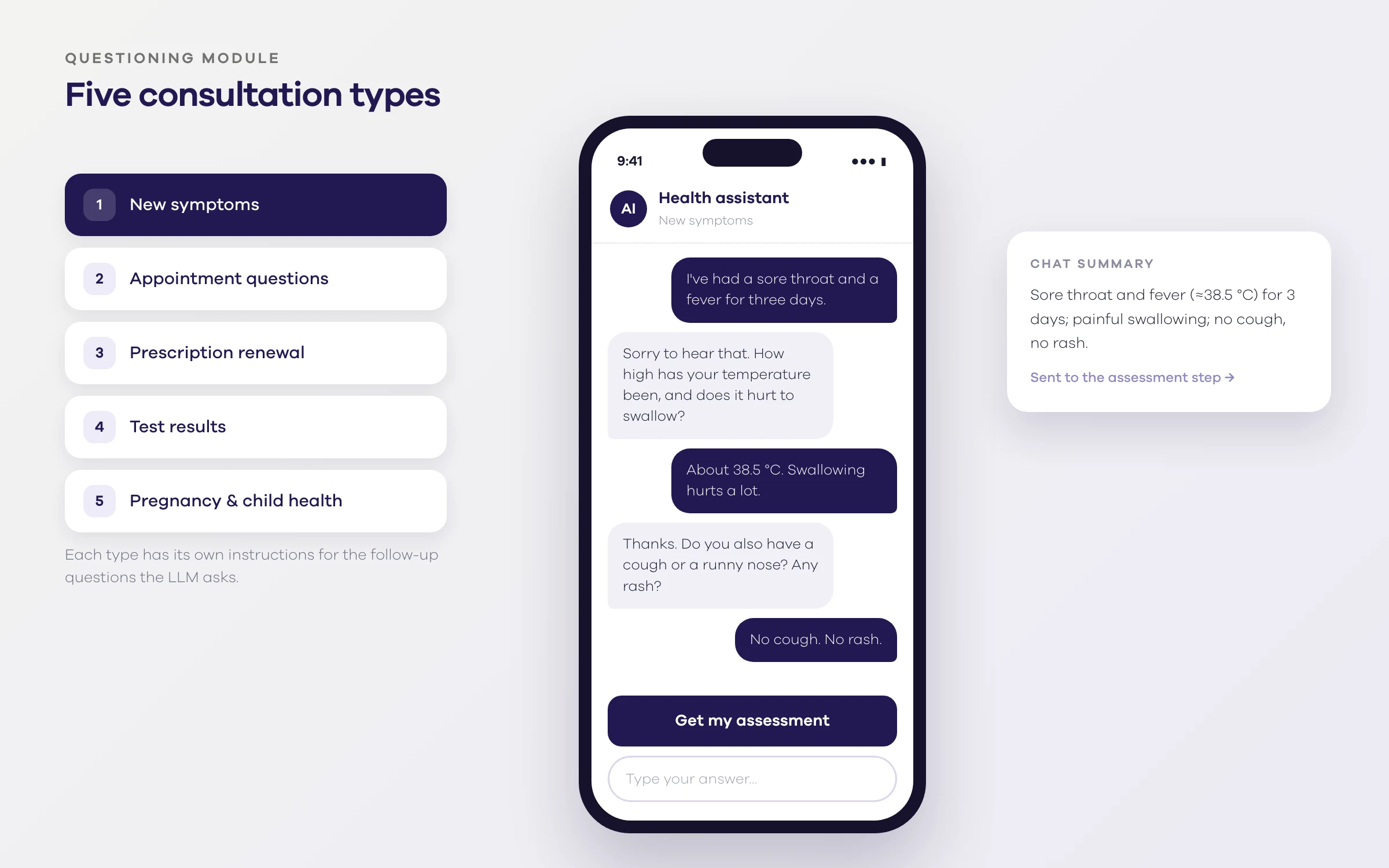
Consultation types, each with its own follow-up questioning instructions
From spec to the merged assessment engine and severity flag (May–Jun 2025)
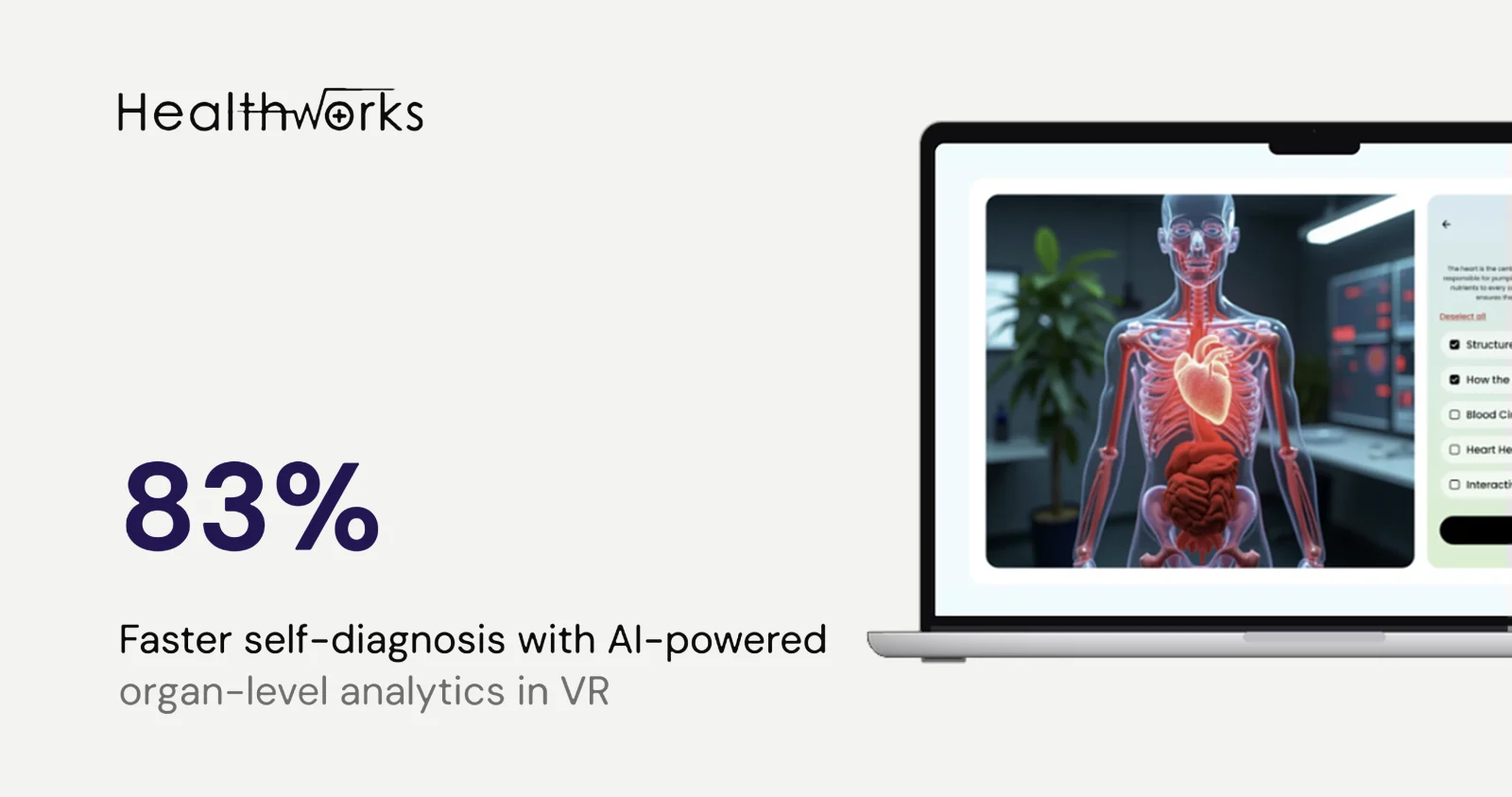
Of plain-language explanation for each possible condition, with read-more detail
A Canadian telemedicine platform wanted patients to describe their problem before the visit: we built the AI back end for that first conversation.
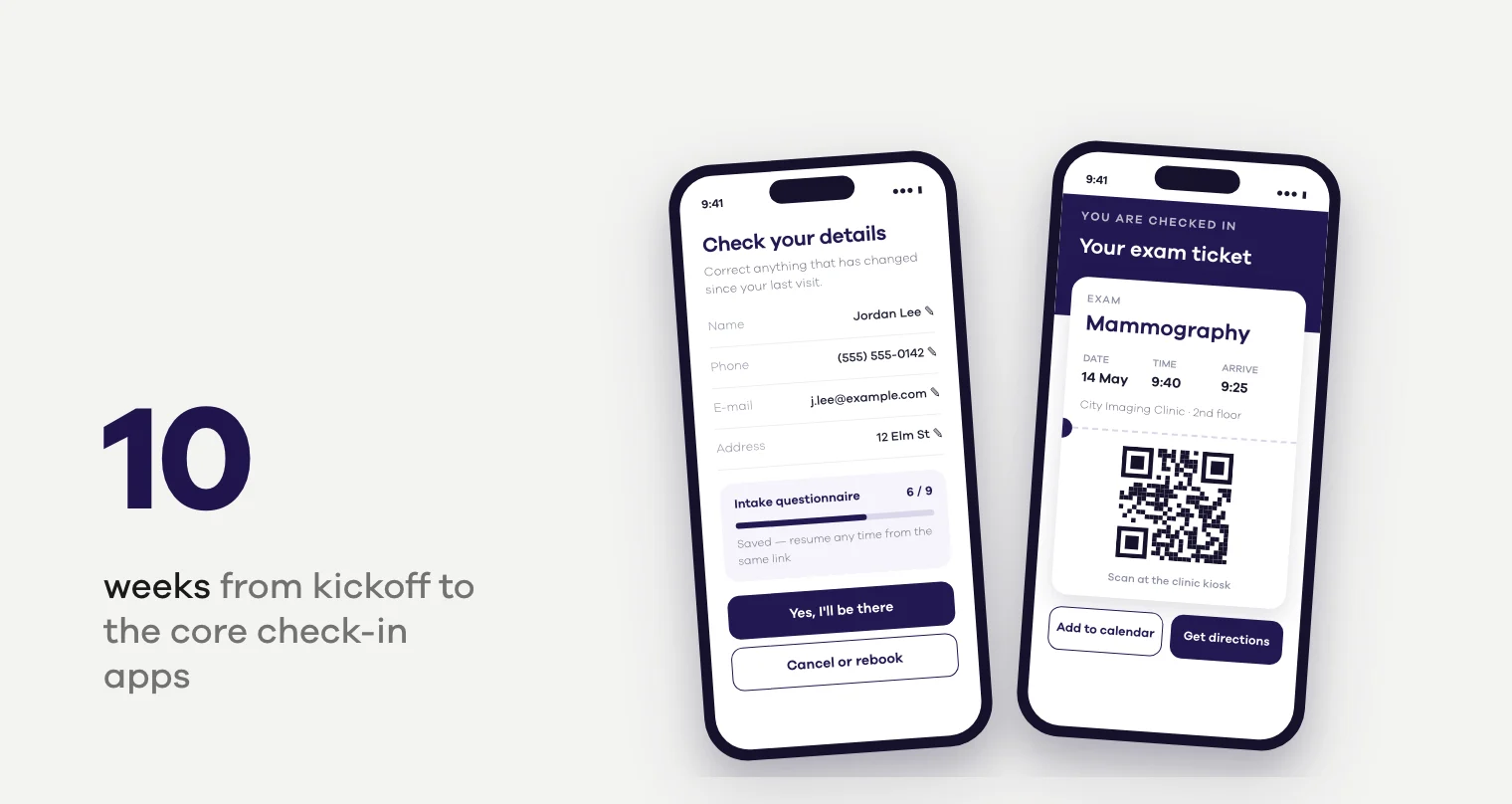
A Canadian imaging network also runs a telemedicine platform where patients book video visits with physicians and radiologists. It wanted patients to describe their problem before the visit, so the platform could pre-fill intake and route each patient to the right kind of consultation. We built the AI back end for that first conversation. We also built the network’s online patient check-in.
Industry
Generative AI, LLM Application Development, Healthcare AI
Services
Canada
Location
Generative AI · LLM application
Engagement
Collect the history before the visit and give physicians a structured summary, not a chat transcript
Basic history should be collected before the visit, so consultation time goes on the clinical conversation. Physicians needed the answers as a structured summary — severity and possible conditions — not a chat transcript. A medical assistant must stay on topic, never present a guess as a diagnosis and make dangerous symptoms obvious. It had to run on Microsoft Azure alongside the rest of the platform, under Canadian privacy rules.
An LLM assistant that asks, assesses and flags severity
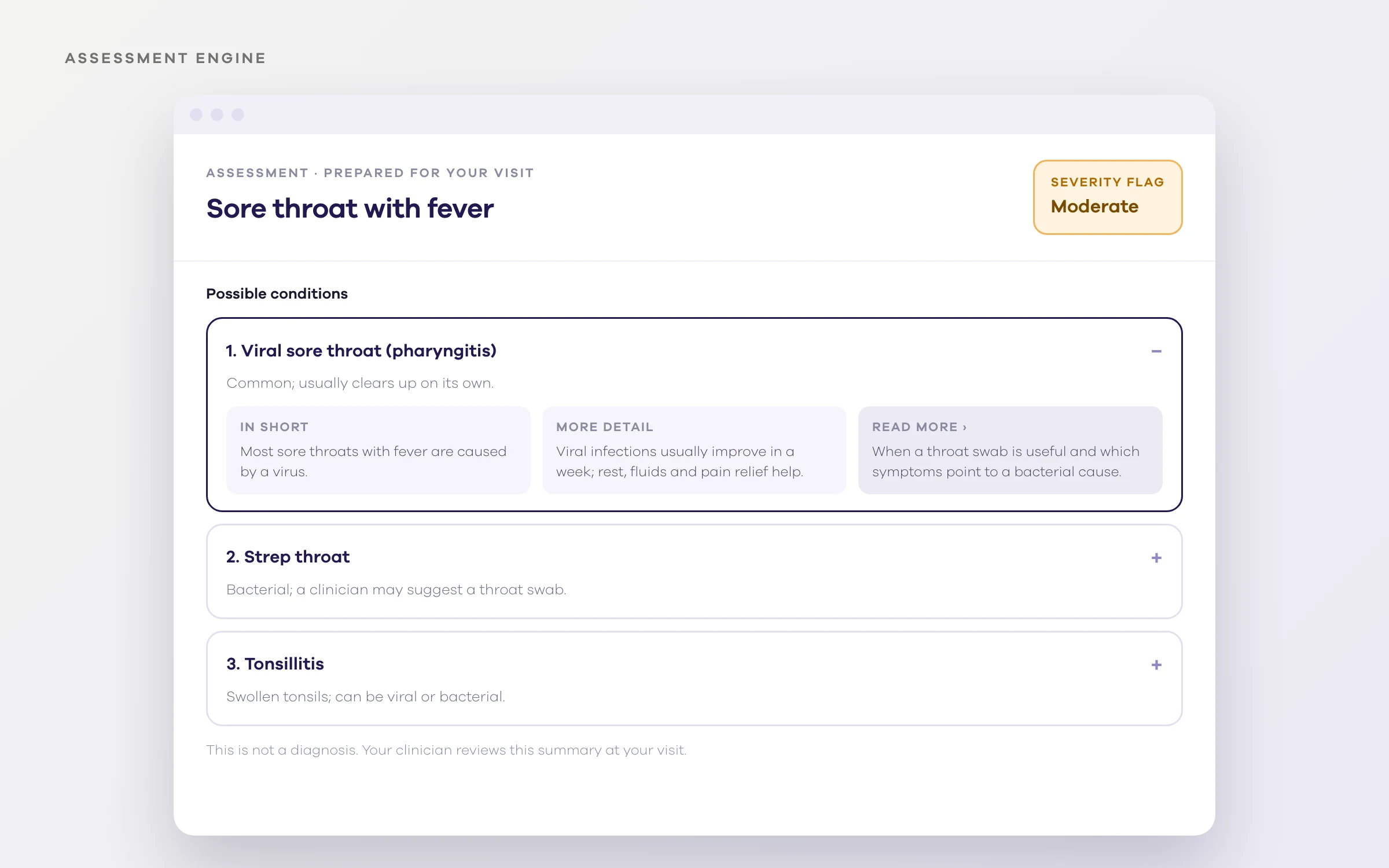
Patients describe their problem in a chat. The assistant asks follow-up questions for one of five consultation types, and a separate assessment step turns the conversation into possible conditions, a severity flag and plain-language explanations that the telemedicine platform can show to patients and clinicians.
What we delivered
Questioning module
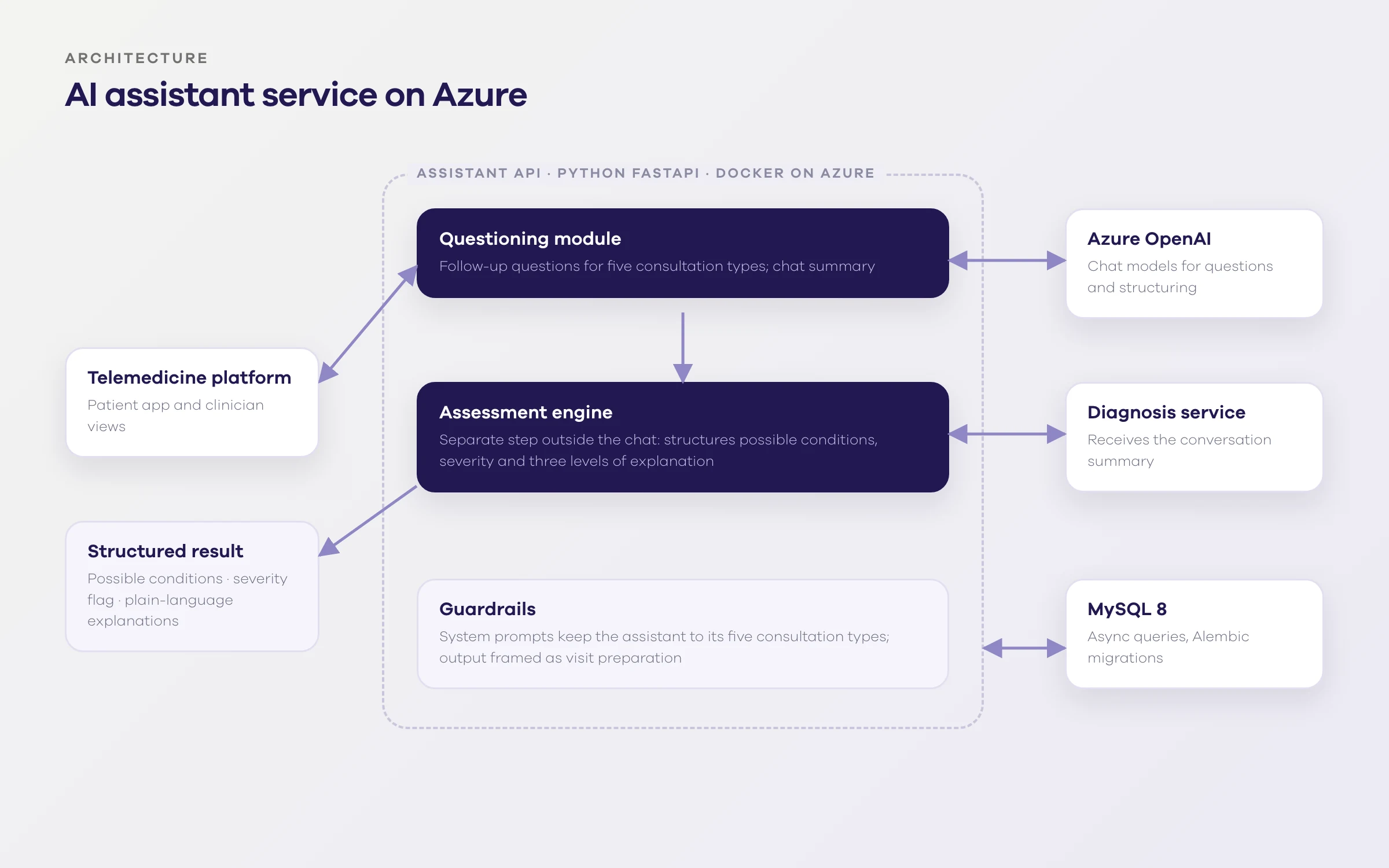
Patients describe their problem in a text chat. The assistant asks follow-up questions generated by the LLM, with separate instructions for five consultation types: new symptoms, appointment questions, prescription renewals, test results, and pregnancy or child health.
Assessment engine
At any point the patient can ask for an assessment. A separate step, outside the chat flow, sends the conversation summary to a diagnosis service, then uses the LLM to structure the result into possible conditions, a severity summary and three levels of plain-language explanation with ‘read more’ detail, exposed through the assistant’s API for the platform to display.
Safety by design
Each assessment carries a severity flag the platform can use to highlight dangerous symptoms. System prompts limit the assistant to its five consultation types, and the assessment is framed as preparation for a clinician, not a diagnosis.
Production on the client’s platform
The service is a Python FastAPI API on Azure OpenAI, deployed on Azure with Docker. In June 2025 we moved it from our repository into the client’s monorepo and migrated its database from SQL Server to MySQL 8 with async queries and Alembic migrations; our engineers kept developing it inside the client’s codebase.
Built with Python, FastAPI and Azure OpenAI
Python and FastAPI for the assistant API, Azure OpenAI chat models for questioning and structuring, SQL Server at first and then MySQL 8 with async queries and Alembic migrations, and Docker on Microsoft Azure for deployment.




Project duration
Two phases, in 2024 and 2025.
Team Size
What the Assistant Delivered
Delivery milestones from the project records.
No. It produces a structured assessment — possible conditions, severity and plain-language explanations — that prepares the patient and the clinician for the visit. The final judgement stays with the clinician.
Azure OpenAI chat models, called from a separate Python FastAPI service on Azure, the same cloud the rest of the platform runs on.
System prompts limit the assistant to five consultation types, a separate assessment step returns structured output instead of free chat, and each assessment carries a severity flag the app can use to highlight dangerous symptoms.
Yes. It runs as a separate service with its own API. Here we later moved it into the client’s monorepo and database, so it deploys with the rest of the platform.
Five consultation types: new symptoms, appointment questions, prescription renewals, test results, and pregnancy or child health. Each has its own instructions for follow-up questions.
The first version (questioning module, summaries, Azure deployment) took about two months in 2024. A five-week sprint in 2025 added the assessment engine, read-more explanations and the severity flag. Integration and clinical review add time on top.